

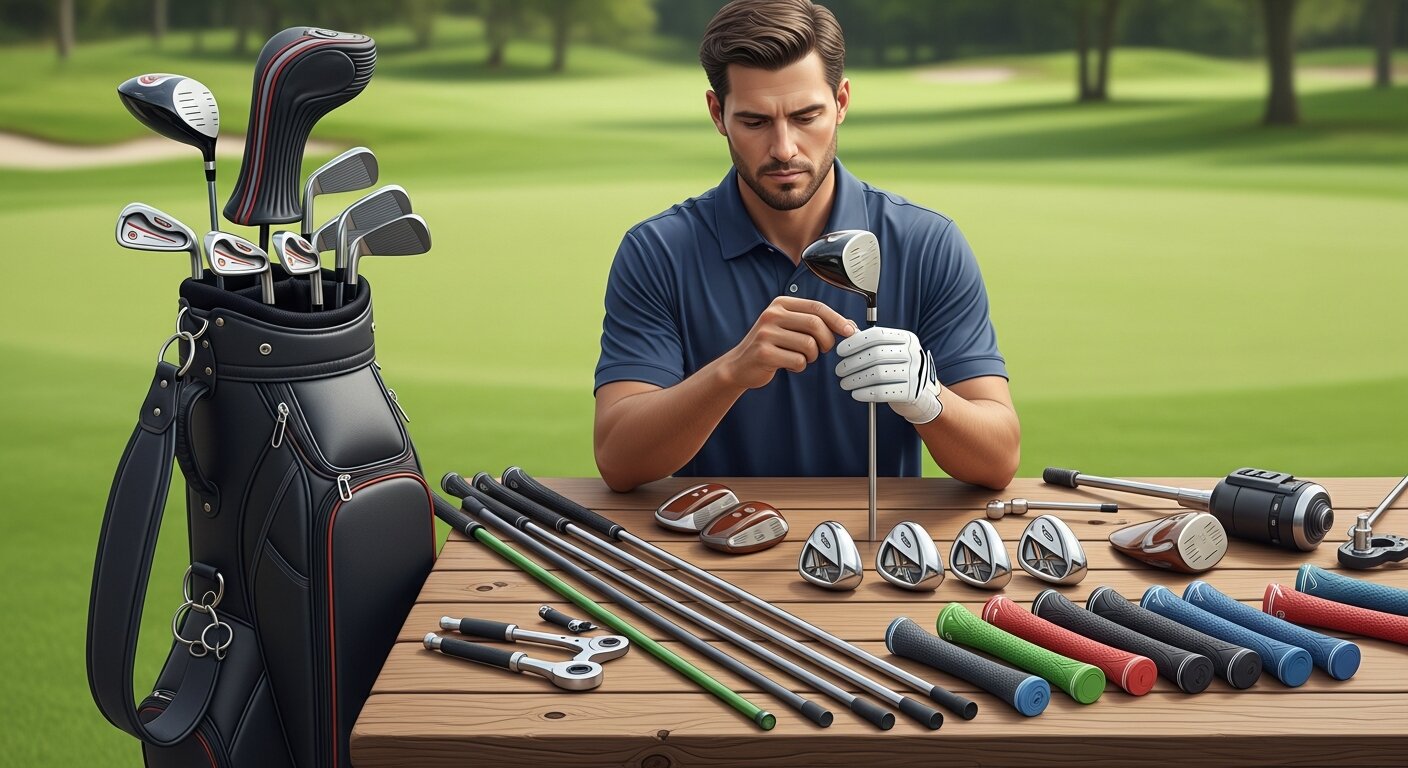
A custom golf set allows you to match every club to your unique swing, body type, and playing style, leading to better distance, accuracy, and consistency. By investing in proper fitting and thoughtful club selection, you can eliminate performance gaps and gain more confidence on the course.
Walking into a golf store and pulling a shiny new set of clubs off the rack might feel satisfying, but it rarely translates to optimal performance on the course. Off-the-shelf options are built for an “average” golfer who doesn’t actually exist. We all have unique heights, swing speeds, and physical tendencies.
Building your own golf set allows you to tailor every single component to your specific mechanics and playing style. When you piece together your bag intentionally, you eliminate gaps in your yardage, maximize forgiveness where you need it, and gain a profound psychological edge. Custom-fitting matters more than ever because golf technology has advanced to the point where micro-adjustments in loft, lie, and shaft flex can shave strokes off your handicap almost overnight.
Understanding the Core Components of a Golf Set

Drivers and Fairway Woods
The driver is the longest club in your bag and plays a crucial role in setting the tone for every hole. When building your custom golf set, selecting the right driver components is essential. You need to consider factors like loft, face angle, shaft flex, and the materials used in the clubhead. Higher-lofted drivers are ideal for players with slower swing speeds, as they help get the ball airborne more easily and improve carry distance. On the other hand, lower lofts are better suited for players with faster swing speeds who want to maximize distance and control trajectory.
Fairway woods are incredibly versatile clubs that serve multiple purposes. You can rely on them off the tee when accuracy is more important than distance, especially on tight fairways. They are also highly effective when hitting from the turf on long par fives or challenging approach shots. Choosing the right loft and shaft for your fairway woods ensures consistency and confidence in different playing situations.
Hybrids and Irons
Hybrids are designed to bridge the gap between difficult-to-hit long irons and fairway woods, making them a valuable addition to any custom golf set. Thanks to their lower center of gravity and wider sole, hybrids are much easier to launch, even from tough lies like rough or uneven ground. They provide a higher ball flight and softer landing, which can significantly improve your approach shots into the green.
Irons form the core of your golf bag and are used for a wide range of shots. They generally fall into two main categories: blades and cavity-backs. Blades are preferred by advanced players because they offer superior control, precision, and shot-shaping ability. However, they require consistent ball striking. Cavity-back irons, on the other hand, are designed with forgiveness in mind. Their perimeter weighting helps reduce the impact of off-center hits, making them ideal for mid to high handicap players who want more consistency and confidence in their game.
Wedges, Putters, and Golf Balls
Wedges are often referred to as your scoring clubs because they play a key role in short-game performance. When building your wedge setup in a custom golf set, you should pay close attention to loft, bounce, and grind. Loft determines the trajectory and distance of your shots, while bounce affects how the club interacts with the turf or sand. A proper bounce angle prevents the club from digging too deeply, especially in softer conditions or bunkers. Grind options further customize how the club performs based on your swing style and typical course conditions.
Putters are highly personal and can have a major impact on your overall score. They come in various designs, including blade and mallet styles, each offering different levels of stability and alignment assistance. The length, weight, and balance of the putter must match your putting stroke to ensure consistency and accuracy on the greens.
Finally, the golf ball is just as important as any club in your bag. Choosing the right ball for your custom golf set depends largely on your swing speed and playing style. Lower compression balls are easier to compress and are better suited for players with slower swing speeds, helping them achieve greater distance and improved feel. Higher compression balls, meanwhile, offer more control and are typically favored by players with faster swings.
Assessing Your Game: The Foundation of Customization

Handicap, Skill Level, and Swing Speed
Before you can build your set, you must be brutally honest about your skill level. High handicappers benefit immensely from game-improvement irons with massive sweet spots and lightweight graphite shafts. Your swing speed heavily dictates your shaft flex. A player swinging a driver at 105 miles per hour needs a stiff shaft to control the clubhead, while someone swinging at 85 miles per hour will generate much more distance with a regular or senior flex shaft.
Ball Flight and Physical Attributes
Understanding your natural ball flight is crucial. If you constantly battle a slice, you can configure your woods with a draw bias or adjust the lie angles on your irons to naturally promote a straighter flight. Your physical attributes also dictate your setup. Your height and wrist-to-floor measurements determine how long your clubs should be and how flat or upright the clubheads need to sit at impact.
The Custom Fitting Process: What to Expect

Professional Fitter vs. DIY Approach
You can gather components and assemble clubs in your garage, but consulting a professional fitter provides data you cannot get on your own. A professional uses advanced launch monitors to track clubhead speed, ball speed, spin rate, and launch angle. If you choose the DIY route, you must rely heavily on trial and error on the driving range.
Key Measurements and Data Analysis
A proper fitting pinpoints your ideal lie angle, loft, shaft length, and grip size. The launch monitor numbers tell the real story. If your spin rate with a driver is pushing 4000 RPMs, a fitter knows instantly that you are losing massive amounts of distance and will adjust the shaft or clubhead to bring that number down to the optimal 2000-2500 RPM range.
Choosing the Right Clubs for Your Custom Set
Drivers, Woods, and Hybrids
When selecting your driver, you must balance forgiveness with workability. If you struggle to find the fairway, opt for a high-MOI (moment of inertia) head. For your fairway woods and hybrids, conduct a gap analysis. You want roughly 10 to 15 yards of distance difference between each club. Ensure you don’t have a 5-wood and a 3-hybrid that travel the exact same distance.
Irons, Wedges, and Putters
Your iron set composition does not have to be traditional. Many players now stop at a 5-iron and replace their 3 and 4-irons with hybrids. For wedges, the “three-wedge system” (pitching, sand, and lob wedge) is incredibly popular, providing options for full shots, bunker escapes, and delicate chips. For the putter, choose a model that visually pleases you and fits your stroke path—whether that is a straight-back-straight-through motion or an arcing stroke.
Shaft Selection: The Engine of the Club
The shaft is the engine that drives the golf club. Choosing between steel and graphite is the first step. Steel is heavier and offers exceptional control and feedback, making it the standard for irons. Graphite is lighter, dampens vibration, and helps generate faster clubhead speeds.
Beyond material, you must nail the flex and weight. A shaft that is too stiff will cause low, right-fading shots, while a shaft that is too flexible will result in high, unpredictable hooks. The kick point, or bend profile, also matters. A high kick point promotes a lower ball flight, while a low kick point helps launch the ball higher.
Grip Considerations: Your Only Connection to the Club
The grip is the only part of the golf club you actually touch, yet it is frequently ignored. Grip size plays a massive role in your ability to release the clubface. A grip that is too thick will restrict your hand action, often leading to a block or push. A grip that is too thin can cause your hands to become overly active, resulting in a hook.
Texture matters for weather performance. Corded grips perform beautifully in the rain or heavy humidity, while soft rubber grips provide a cushioned feel for players with sensitive joints. Proper installation is critical to ensure the grip aligns perfectly with the clubface.
Assembling Your Set: Practical Tips
When building your set, you can source components directly from manufacturers, buy used clubs to harvest their shafts and heads, or work with a custom builder. If you are assembling them yourself, you will need basic tools like a vise, grip tape, solvent, and epoxy.
Remember the USGA rules: you are limited to 14 clubs in your bag. This limit forces you to make strategic choices. If you play a course with tight fairways, you might add a driving iron. If you play a course with deep bunkers, an extra high-lofted wedge might be the better choice.
Maintaining Your Custom Golf Set
Once you have built your perfect set, protecting your investment is key. Clean the grooves of your irons and wedges after every single shot with a stiff brush and water. Dirt and debris in the grooves drastically reduce spin and control.
Schedule regular check-ups for your clubs. Lie and loft angles on forged irons can bend slightly over time from repeated turf interaction, so have them checked annually. You should also re-evaluate your set as your game changes. If you start working out and swinging faster, your old shafts might no longer support your new mechanics.
The Rewards of a Perfectly Tailored Game
Taking the time to build your own golf set is a deeply rewarding experience. It forces you to understand the mechanics of your own swing and the technology behind the equipment. When you step onto the first tee with a bag of clubs specifically engineered for your body and your game, your confidence skyrockets.
Do not let the complexity deter you. Start small, perhaps by getting fitted for a new driver or a fresh set of wedges, and slowly build out the rest of your bag. The joy of playing with clubs truly made for you is an experience every golfer deserves.
