


Mastering Grip and Posture
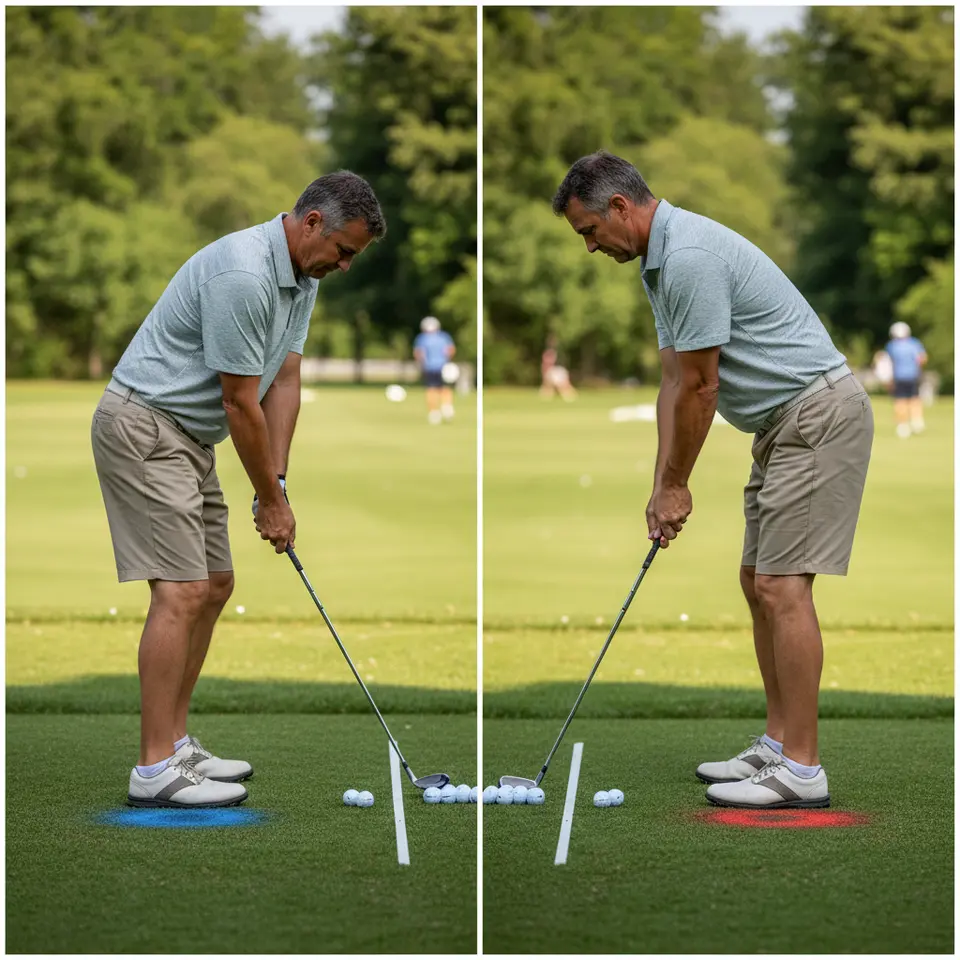
Successful golf swings start from the ground up. A balanced stance and neutral grip create the foundation for consistent ball striking. Stand with your feet shoulder-width apart, knees slightly flexed, and weight evenly balanced on the balls of your feet. Maintain an athletic posture with light tension in the thighs, allowing free movement without stiffness. Alignment aids can help ensure your shoulders, hips, and feet are parallel to the target line, promoting a smooth and accurate swing path.
Grip pressure is equally important for controlling the clubface and maintaining control throughout the motion. Hold the club mainly in the fingers of your lead hand, with the trail hand supporting naturally so the “V” shapes point toward the trail shoulder. A neutral grip helps maintain consistency and reduces unwanted shot shapes.
Good balance and core engagement also play a key role. Keep your core lightly engaged and maintain a slight forward hip tilt to support posture and encourage solid contact. Avoid excess weight on the heels or toes, as this can affect stability. Simple drills like the wall drill or using alignment sticks can quickly improve setup consistency.
Modern tools such as pressure mats and video analysis provide helpful feedback on balance and positioning, making it easier to correct small errors. By focusing on these fundamentals, you build a stable base that reduces mistakes and helps you refine your golf swing with greater consistency and confidence.
Key Takeaways
- Align feet, hips, and shoulders parallel to the target.
- Maintain a neutral grip with balanced pressure.
- Distribute weight evenly and engage the core.
- Keep a slight hip tilt for a descending strike.
The Kinematics of Your Swing: From Backswing to Downswing

Understanding the sequence of movements from takeaway to impact is essential for generating power and maintaining accuracy. Today, golf instructors emphasize a kinetic chain that initiates from the ground up, transferring energy through the legs, core, and upper body before releasing it through the clubhead.
Takeaway and Initial Rotation
Begin your backswing by moving the clubhead low and wide along the target line for the first few inches. Keep the wrists passive to avoid casting the club and losing stored energy. As your arms swing back, allow your shoulders to turn fully while the hips rotate naturally. The trail knee should flex slightly, enabling a smooth coil without over-rotating the lower body. This coil stores potential energy that will power the downswing.
Reaching the Top
At the top of your swing, your lead shoulder should position under your chin, while your back faces the target. The wrists should hinge to create an ideal 90-degree angle between the club shaft and forearm. Maintaining this hinge maximizes torque as you transition into the downswing. Avoid excessive arching of the lower back, which can lead to loss of posture and inconsistent strikes.
Transition and Downswing
Initiating the downswing correctly is where many golfers struggle. Instead of pulling the club down with the arms, shift your weight toward the lead foot and steer the hips open toward the target. This hip rotation, combined with a slight drop of the trail shoulder, allows the arms and club to follow naturally. Holding the wrist angle until the final moments builds lag, a critical component for increased clubhead speed.
During the downswing, maintain a consistent swing plane. Using an alignment stick or training aid positioned along your intended swing path helps you visualize the correct angle. A shallow approach produces a more sweeping motion, while a steeper plane favors a descending blow. The ideal attack angle varies with club selection and shot type but understanding your natural swing plane helps you make deliberate choices on course.
By dissecting these kinematic stages and practicing each component individually, you develop a more repeatable motion. Recording your swing and comparing it to reference models, such as those from the United States Golf Coaches Association, can reveal breakdowns that you might not feel. With targeted practice today, you can sequence your body efficiently to perfect your golf swing.
Optimizing Impact and Follow-Through
Crisp contact and a balanced finish are the hallmarks of a well-executed swing. In today’s competitive environment, golfers seek to dial in their impact zone to control launch conditions and spin rates for greater precision.
Delivering the Clubhead
As you approach the ball, maintain a slight forward shaft lean, ensuring that the hands lead the clubhead through impact. This descending blow compresses the ball against the turf, producing a penetrating flight. Visualize striking the ball before the grass to reduce mishits and poor turf interaction.
Maximizing Clubhead Speed
Grip pressure should remain firm yet relaxed, preventing tension that can bottleneck wrist release. At impact, allow the grip to sit deep in the fingers, transmitting maximum energy to the ball. To increase speed without sacrificing control, focus on a one-piece takeaway drill and a weighted training club that promotes a full shoulder turn.
Securing the Finish
Targeted Drills and Practice Strategies

Deliberate practice underpins any effort to perfect your golf swing. Random ball-hitting rarely translates into meaningful improvement. Instead, structure your training sessions around focused drills designed to isolate one aspect of your motion at a time. By compartmentalizing practice, you can accelerate skill acquisition and build a more consistent motion.
Pause-at-the-Top Drill
This drill emphasizes tempo and transition. Bring the club to the top of your backswing and hold it in place for one to two seconds. This pause allows you to confirm correct wrist hinge and proper coil, while preventing an arms-first rush into the downswing. Complete the swing smoothly after the pause, focusing on maintaining lag and balanced acceleration.
Alignment Stick Routine
Alignment sticks are inexpensive yet powerful tools. Lay one stick on the ground along your target line and another parallel to your toe line. Practicing with these visual guides reinforces consistent stance width and swing path. Over time, your body will internalize these positions, reducing the need for physical aids.
Impact Bag Drill
Hitting an impact bag is an effective way to grooved leading-hand compression through the strike zone. Set up a soft bag at the height where the club should meet the ball. Swing down intentionally, focusing on keeping your hands ahead of the clubhead. You will feel the correct impact sequence and receive instant tactile feedback if your path or tilt is off.
Variation Practice
To translate range gains to on-course performance, practice under varied conditions. Hit balls from tight lies, uphill and downhill stances, and in windy scenarios to mimic real-world challenges. Incorporate pressure by setting performance targets or competing against practice partners.
Split-Routines
Divide your practice into segments—two stations dedicated to half-swings and tempo drills, one for full-swing speed work, and another for short-game and putting. This splitter approach ensures balanced progress across all areas of your game, preventing overemphasis on one component.
For data-driven golfers, use shot-tracking apps or launch monitors to record metrics such as clubhead speed and dispersion. Analyzing trends over time provides objective insight into your development and highlights areas that require further attention. By following a structured practice plan, you can methodically perfect your golf swing and achieve lasting consistency.
Overcoming Common Pitfalls and Applying Advanced Adjustments
No swing is perfect from the outset. Even seasoned players fall into technical traps that hinder consistency. Recognizing and eliminating these flaws accelerates progress and leads to breakthroughs in ball-striking.
Avoid Overactive Hands
Flipping or scooping with the hands at impact often results from lack of body rotation or early release. To counter this, practice the toe-up drill: swing until the club shaft is parallel to the ground on both backswing and downswing, feeling the clubhead toe pointed upward. This encourages proper wrist hinge and prevents premature hand action.
Maintain Posture to Prevent Early Extension
Standing up out of your posture—known as early extension—robs you of power and leads to fat or thin shots. Use the wall drill for backswing and downswing phases. Place your buttocks lightly against a wall during your swing to feel the correct spine angle. This drill discourages upward movement of the hips and promotes rotation.
Correct Hip Swath
Swaying the hips laterally instead of rotating them can misalign your swing plane. Try the rope-around-belt drill: loop a resistance band or rope around your belt and anchor it to a stable object. Perform slow swings to prioritize rotational movement without lateral shift. This builds muscle memory for on-plane rotation.
Advanced Video Analysis
Once you’ve resolved major swing flaws, leverage advanced video analysis software. High-speed recordings and 3D motion capture provide granular data on joint angles and rotation speeds. Many collegiate programs, such as those at Stanford University, employ these technologies for athlete development. Access to such insights enables players to fine-tune their motion beyond what the eye can see.
Mental and Physical Integration
Sustained improvement ties to both the mind and body. Incorporate visualization techniques by mentally rehearsing your swing before stepping up to the ball. Combine this with a dynamic warm-up routine that addresses mobility and stability. Exercises like single-leg squats, torso rotations, and banded hip stretches prepare the neuromuscular system for the demands of the swing.
By systematically addressing common mistakes and applying advanced adjustments, you elevate your practice to a new level. Integrating biomechanics, mental strategies, and modern technology ensures that today’s efforts translate into measurable gains on the course. Stay committed and patient, and you will perfect your golf swing with both precision and confidence.
FAQ
How often should I practice to see improvements in my golf swing?
Aim for short, focused practice sessions 3–4 times a week, incorporating drills that target specific swing elements. Consistency and deliberate practice are more effective than sporadic, lengthy sessions.
Is video analysis necessary for improving my swing?
While not mandatory, video analysis provides visual feedback that can reveal flaws not felt during the swing. When combined with coaching, it accelerates learning and helps track progress over time.
Can distance and accuracy improve simultaneously?
Yes. By mastering a stable setup, efficient energy transfer, and precise impact mechanics, you can increase clubhead speed (distance) without sacrificing control (accuracy).
Conclusion
Perfecting your golf swing requires a mix of strong fundamentals, consistent practice, and continuous improvement. With access to modern tools like video analysis and expert guidance, golfers can better understand and refine their technique. Focusing on grip, posture, swing sequence, impact, and follow-through builds a reliable and repeatable motion.
Using targeted drills and correcting common mistakes helps improve accuracy and consistency over time. Mental focus, proper warm-ups, and physical conditioning also play an important role in long-term success. By following these principles, you can steadily improve your performance and enjoy a more confident and consistent golf game.
