


Selecting the right golf ball can be as critical as refining your swing. Golf ball technology has advanced rapidly, blending material science, aerodynamics, and digital testing to produce models that cater to every style of player. Currently, engineers and researchers collaborate with leading universities and institutions to push the boundaries of what a golf ball can deliver. In this article, we dive deep into the intricate world of golf ball technology, explaining how innovations in core construction, cover materials, dimple design, and flight optimization come together to influence distance, control, and feel.
Whether you’re a beginner chasing more carry or an experienced player seeking precise greenside spin, understanding the nuances of golf ball technology will help you make an informed choice. We will explore the historical evolution of these spherical marvels, dissect their internal components, and guide you through matching ball characteristics with your swing speed and typical course conditions. You’ll be equipped with the knowledge needed to select the perfect ball for your game in today’s digital landscape.
The Evolution of Modern Golf Ball Technology

Golf ball technology has come a long way since the days of featheries and gutta-percha spheres. Early golfers played with materials ranging from wooden blocks to stitched leather shells filled with feathers. As polymer chemistry evolved, manufacturers introduced solid-core constructions in the mid-20th century, vastly improving energy transfer and consistency. Today, many companies employ advanced computational fluid dynamics (CFD) simulations—often in partnership with institutions like NASA, to fine-tune dimple patterns and optimize aerodynamic performance.
Recent breakthroughs involve nanocomposite materials and variable-density cores that adjust rigidity from the center outward. These innovations allow for precise control over launch angles and spin rates, providing a more uniform performance for players across all swing speeds. Academic studies from top engineering schools, such as those published by the Massachusetts Institute of Technology, highlight how microstructural design can influence resilience and feel. As a result, today’s premium golf balls offer a delicate balance between explosive distance and controllable spin.
Manufacturers now release multi-layer designs with up to five distinct strata, each serving a specific function. The innermost core often focuses on maximizing ball speed, while intermediate mantle layers manage energy transfer and spin. The outer urethane or ionomer cover then refines the feel and greenside control. This layered approach is a direct outcome of decades of research and development, reflecting the game’s shift toward customized performance solutions for every type of golfer.
Core Construction and Compression Dynamics
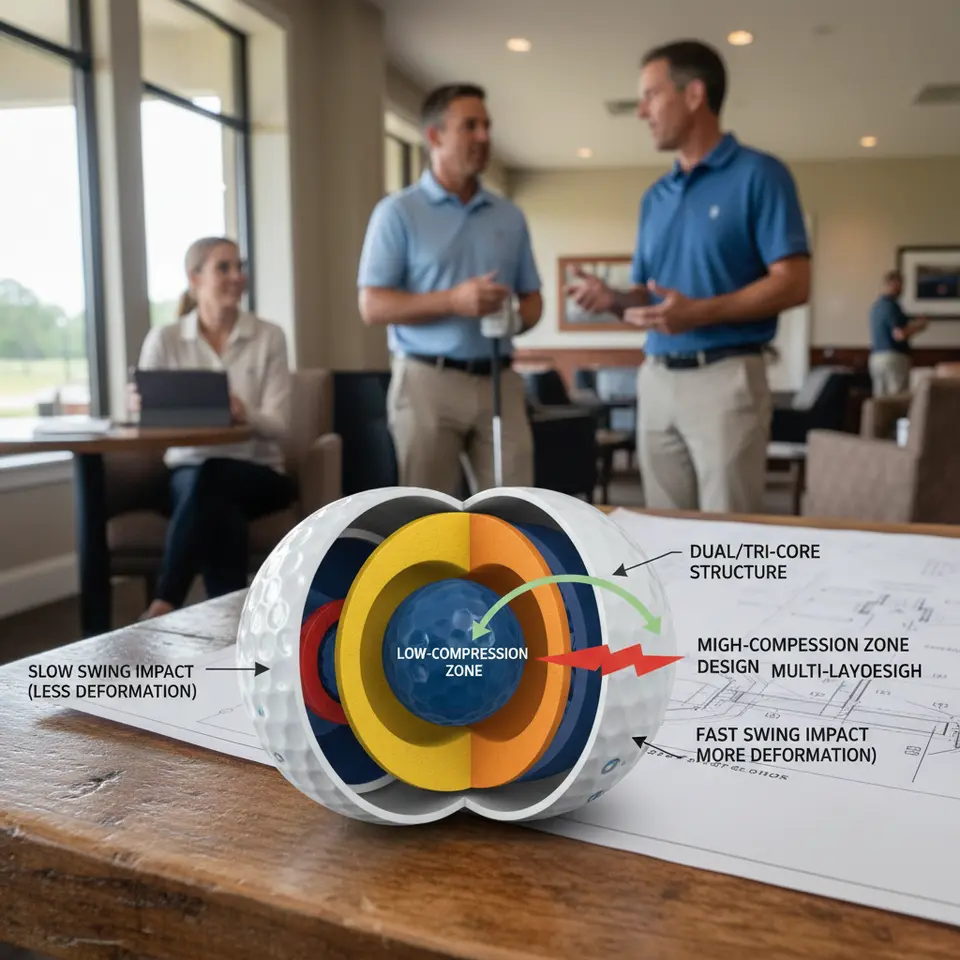
The heart of golf ball technology lies in its core design. Modern cores are typically composed of synthetic rubbers, resins, and polymer blends engineered for specific compression ratings. Compression measures how much the ball deforms under the high-speed impact of a clubface. Lower-compression cores (60–80) tend to compress more easily, offering softer feel and additional spin for slower swing speeds. In contrast, high-compression cores (90–110+) provide maximum energy return for faster swingers seeking greater ball speed.
Advanced dual-core and tri-core constructions allow manufacturers to vary compression within the same ball. For example, an inner core might be engineered to promote rapid initial velocity, while an outer core layer provides stability and spin control. These layered cores are designed using precise molds and injection techniques to maintain consistent performance. Tracking data from launch monitors, such as TrackMan and FlightScope, demonstrates how core compression directly affects launch angle and spin loft, illustrating why selecting the right compression is vital for optimizing distance.
When evaluating golf ball technology, pay attention to each model’s published compression rating. Players with swing speeds below 90 mph will often see better results with low-compression balls, experiencing higher launch and more forgiveness. Those swinging above 105 mph can exploit high-compression designs to reduce unwanted spin and increase roll-out. Manufacturers typically recommend swing-speed ranges for each model, simplifying the decision-making process when shopping for new golf balls.
Cover Materials and Dimple Innovation
The outer cover of a golf ball plays a pivotal role in feel, spin, and durability. Two primary materials dominate the market: Surlyn and urethane. Surlyn, an ionomer resin introduced in the 1960s, is prized for its toughness and affordability. It tends to produce a firmer feel with moderate spin, making it ideal for two-piece distance balls aimed at casual players. Urethane covers, by contrast, offer a softer touch and enhanced greenside spin, favored by advanced golfers prioritizing control over raw distance.
Dimple patterns work hand-in-hand with cover materials to craft a ball’s aerodynamic profile. Dimples induce turbulent airflow around the sphere, reducing drag and maximizing lift. Pattern designs vary widely, from classic 332 dimple arrays to modern hexagonal or variable-depth configurations. Lower-spin prescription balls often feature shallower, wider dimples to lower lift and encourage rollout on firm fairways. High-spin models, conversely, utilize deeper or tighter dimple patterns to increase lift and stopping power on approach shots.
Researchers at the United States Golf Association continue to study how dimple geometry affects ball flight under different humidity and temperature conditions. Their findings help manufacturers tailor dimple counts and arrangements for specific playing environments. For players, understanding these subtle variations in golf ball technology can translate into better shot consistency, whether battling windy seaside holes or navigating tree-lined parkland courses.
Matching Ball Characteristics to Swing Speed and Course Conditions

Choosing the correct golf ball is not a one-size-fits-all decision—it requires aligning ball characteristics with individual swing dynamics and playing environments. Swing speed, launch angle, and spin rate are fundamental variables that interact with core compression and cover materials. Players swinging under 90 mph typically benefit from low-compression, high-launch balls that maximize carry. Those in the 90–105 mph range often find mid-compression, multilayer balls strike the best balance between distance and control.
Course conditions further influence ball selection. In dry and firm settings, low-spin, low-carry balls with faster rollout can add valuable yards, whereas wet, soft turf demands higher-spinning, softer-covered models for improved stopping power. Altitude also plays a role—higher elevations reduce air density, so lower-launch, lower-spin golf balls help maintain control. Windy seaside links require aerodynamically-optimized, low-spin options to prevent ballooning. Testing different models in practice rounds—and reviewing launch monitor feedback—ensures you pinpoint the ideal match for your typical courses.
Many manufacturers publish recommended swing-speed and condition-specific guidelines for each model. Use this data alongside your own tracking results to simplify the selection process. By focusing on how golf ball technology interacts with your swing and course variables, you’ll achieve better consistency and more confidence in every shot.
Maintenance, Longevity, and Future Trends
Even the best golf ball technology can degrade without proper care. After each round, rinse balls with clean water to remove dirt, grass, and moisture that may alter aerodynamics. Inspect for nicks or scuffs, as even minor surface damage can cause unpredictable spin and flight deviations. Store balls at room temperature, avoiding extreme heat or direct sunlight, which can weaken core materials. Many players personalize balls with alignment marks using fine waterproof pens to ensure durability of their custom logos.
Looking ahead, golf ball technology is set to evolve through breakthroughs in nanomaterials and additive manufacturing. Researchers are developing variable-density cores using 3D-printed polymers, custom-tuned to each player’s swing profile. Artificial intelligence and machine learning will soon optimize dimple arrays in real time, crafting personalized aerodynamics for individual course conditions. Moreover, eco-friendly materials derived from bio-based polymers aim to reduce the environmental impact of lost or discarded balls.
Staying current with these innovations—by following publications from leading research universities and institutes—empowers golfers to benefit from the latest advancements. As smart sensors become integrated into ball designs, players will gain immediate feedback on spin, launch, and impact location, ushering in a new era of data-driven improvement. In today’s digital landscape, those willing to embrace emerging golf ball technology will enjoy a competitive advantage both on the course and in their practice routines.
FAQ
How do I choose the right compression rating?
The compression rating correlates with swing speed: players under 90 mph benefit from low-compression balls (60–80) for higher launch and spin, while those above 105 mph gain more distance from high-compression ratings (90–110+). Always reference the manufacturer’s guidelines and use launch monitor data if available.
What’s the difference between Surlyn and urethane covers?
Surlyn is a durable ionomer resin that delivers a firmer feel with moderate spin, ideal for casual players seeking distance. Urethane offers a softer touch and enhanced greenside spin, preferred by advanced golfers prioritizing control and feel around the greens.
How do dimple patterns affect ball flight?
Dimples create a turbulent boundary layer, reducing drag and optimizing lift. Shallow, wide dimples lower spin and encourage rollout, while deeper, tighter patterns increase lift and stopping power, especially in high-spin models. Environmental factors like temperature and humidity further influence dimple performance.
Can I improve performance by testing different balls?
Yes. Testing various models on practice ranges or using launch monitors can reveal how core compression, cover materials, and dimple designs interact with your swing. This hands-on approach helps you select a ball tailored to your speed, playing conditions, and performance goals.
Conclusion
Golf ball technology today offers an unprecedented blend of distance, control, and feel, driven by advances in materials science and aerodynamic research. By understanding how core compression, cover materials, dimple innovation, and environmental factors interact with your swing speed, you can select a ball that enhances every aspect of your performance. Whether you prioritize extra yards off the tee or pinpoint greenside spin, matching your game to the right ball is crucial.
Maintaining proper ball care and staying informed about emerging trends—like nanocomposite cores and AI-optimized dimple patterns—will keep you ahead of the curve. With the right golf ball in play, backed by authoritative data and personal testing, you’ll enjoy greater consistency, confidence, and enjoyment on the course.
