

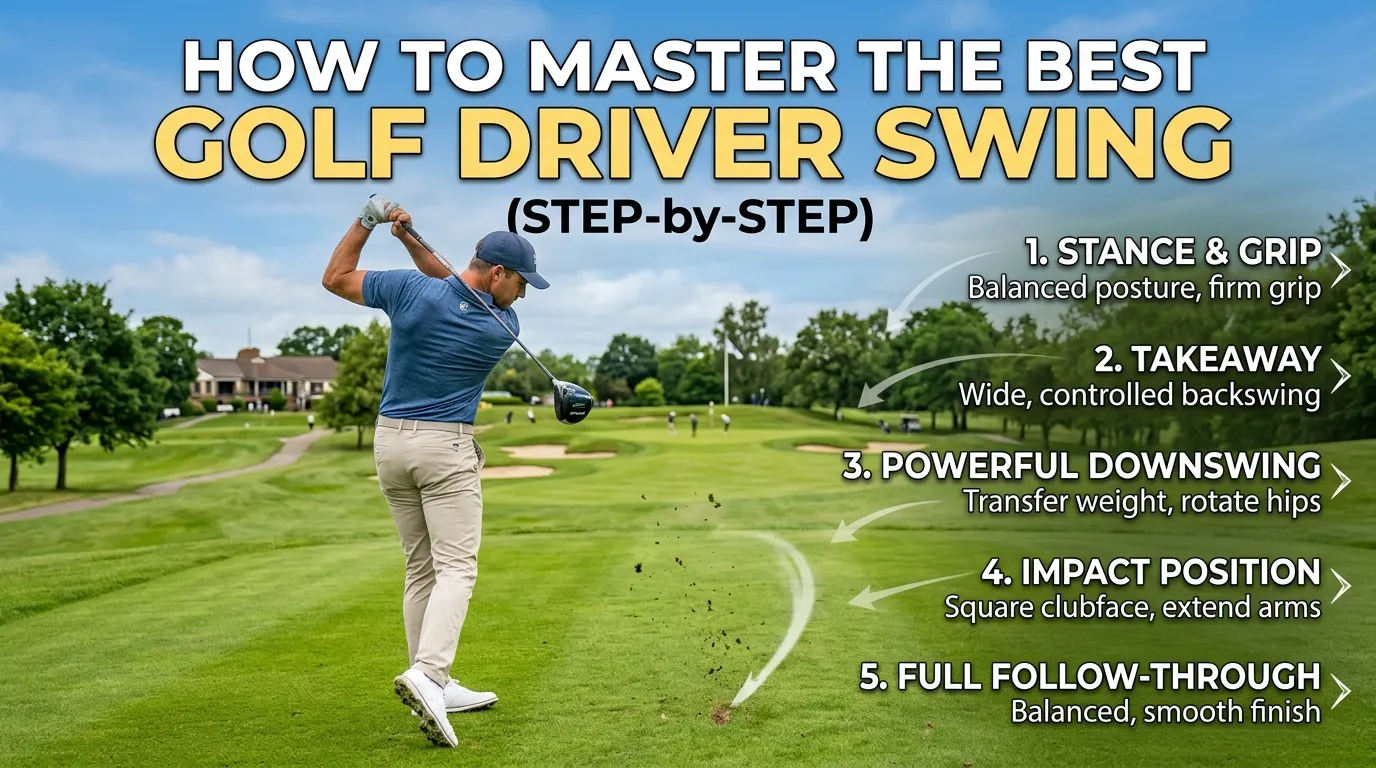
A strong Golf Driver Swing is built on solid fundamentals like proper setup, full shoulder turn, smooth transition, and a positive attack angle. Focusing on balance, timing, and clean contact helps improve both distance and accuracy. With consistent practice and correct technique, golfers can eliminate common mistakes and develop a more reliable and powerful drive.
The best golf driver swing combines a proper setup, a wide takeaway, full shoulder turn, and a smooth transition from the top. Focus on hitting up on the ball (positive attack angle), maintaining lag, and rotating through impact. Beginners should prioritize consistency over power before adding distance.
Few things in golf feel as satisfying as a perfectly struck driver. That low, piercing ball flight. The effortless crack at impact. The ball tracking straight down the middle of the fairway.
But for most golfers, the driver is also the most frustrating club in the bag. Too much slice. Not enough distance. A swing that looks nothing like what you picture in your head. Sound familiar?
The good news: driver swing mechanics are learnable. You don’t need elite athleticism or a natural gift for the game. What you need is a clear understanding of how the swing works, what common mistakes to avoid, and a set of drills you can practice consistently. This guide covers all of that—from the perfect driver setup and stance to advanced swing drills that will help you hit the ball straighter and farther than ever before.
Whether you’re a beginner picking up a driver for the first time or a mid-handicapper looking to shave strokes off your game, this breakdown will give you something actionable to work with.
What Makes a Great Golf Driver Swing?
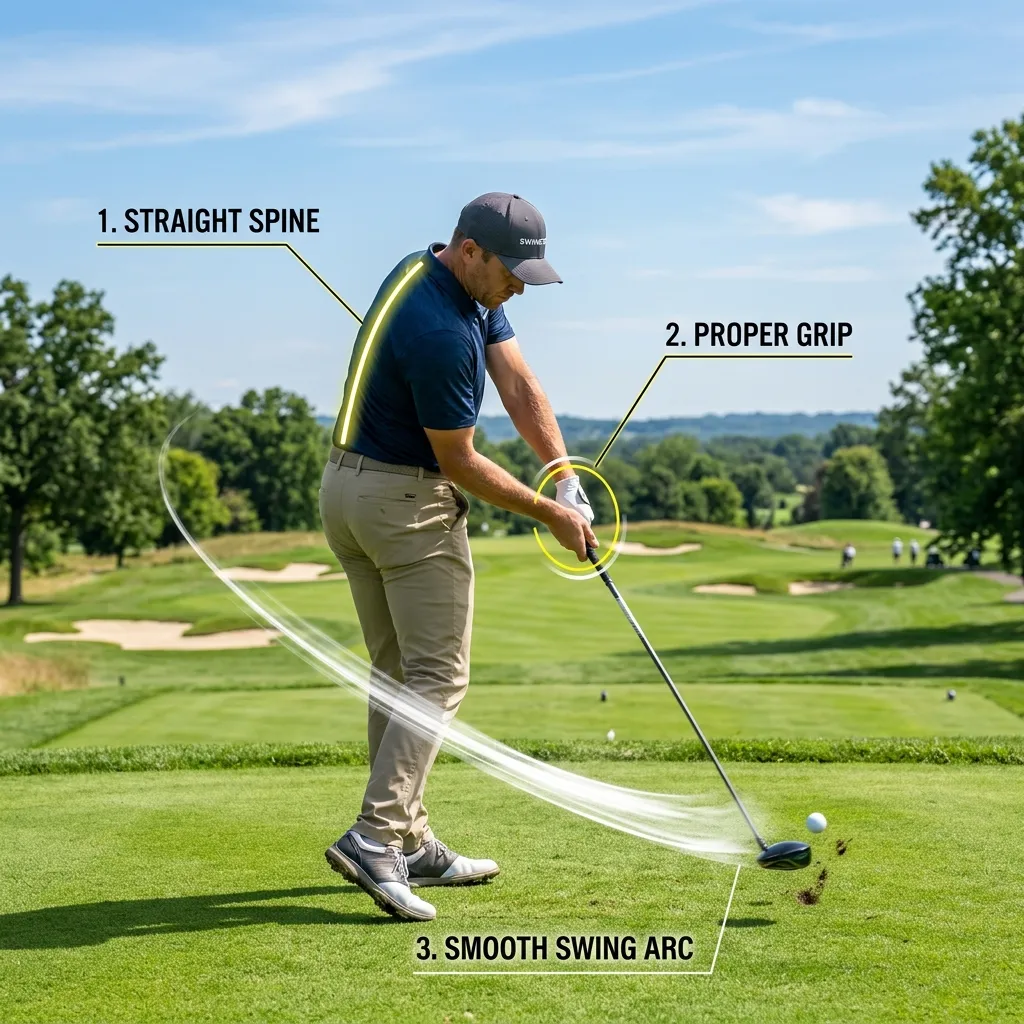
The best golf driver swing optimizes three things: club path, face angle at impact, and attack angle. According to Trackman golf data, the majority of amateur golfers swing the driver on an out-to-in path with a negative attack angle—two factors that produce weak, slicing shots with a steep descent into the ball.
Professional golfers, by contrast, typically swing on a neutral-to-in-to-out path with a positive attack angle (hitting up on the ball by 3–5 degrees). This combination launches the ball higher with less spin, producing more distance and straighter flight.
Understanding these fundamentals gives you a blueprint. Now let’s build the swing from the ground up.
Golf Driver Setup and Stance: Build the Foundation First
Before you even take the club back, your setup determines a huge portion of the outcome. A poor setup makes a good swing nearly impossible.
How should you position the ball when hitting a driver?
Ball position is critical with the driver. Unlike irons, which you want to hit on a slightly descending blow, the driver requires an ascending strike. To achieve this, position the ball just inside your lead heel (left heel for right-handed golfers). This encourages the upward attack angle needed to maximize distance.
What is the correct stance width for a driver swing?
Your feet should be roughly shoulder-width apart—or slightly wider. A wider base creates a stable platform for the rotation your swing requires. Flare both feet slightly outward (around 20–30 degrees) to allow your hips to clear through impact without restriction.
How should your weight be distributed at address with a driver?
Set up with approximately 60% of your weight on your trail side (right side for right-handers). This slight tilt away from the target—combined with the forward ball position—naturally encourages the upward strike you need.
Your spine should tilt slightly away from the target too. Think of creating a subtle “Y” shape with your arms and club at address, with your lead shoulder slightly higher than your trail shoulder.
Perfect Driver Swing Technique: The Backswing

What does a proper driver takeaway look like?
The takeaway sets the tone for everything that follows. Keep the clubhead low and wide as you begin moving it away from the ball. Avoid picking the club up steeply with your hands and arms—this narrows the swing arc and robs you of power.
A useful cue: feel like you’re pushing the clubhead away from the ball along the ground for the first foot of the swing. This promotes a wide arc, which is a key ingredient in generating clubhead speed.
How much should you rotate your shoulders in a driver backswing?
Aim for at least 90 degrees of shoulder turn at the top of your backswing. Your lead shoulder should feel like it’s pointing at the ball. Hip restriction (turning them less than your shoulders) creates what’s known as “X-factor”—the coil between your upper and lower body that stores power for the downswing.
At the top of your backswing, your weight should have shifted comfortably to your trail foot, your lead arm should be relatively straight, and the club should be roughly parallel to the ground.
Driver Swing Mechanics: The Downswing and Impact
How do you start the downswing correctly in a driver swing?
This is where most amateur golfers lose the shot. The biggest mistake at the top of the swing is initiating the downswing with the arms and hands. This causes the club to come over the top—the root cause of the dreaded slice.
Instead, start the downswing by shifting your weight and pressure toward the lead foot while your upper body and arms remain “loaded.” Think of it as your lower body leading, your upper body following. This sequence allows the club to drop into a shallower, more powerful delivery path.
What should happen at impact with a driver?
At impact, your hips should be open to the target (roughly 30–45 degrees), your hands should be just ahead of the clubhead, and your weight should be firmly on your lead side. Your head should remain slightly behind the ball—a natural result of that trail-side tilt established at address.
The club face angle at impact is the single biggest factor in determining where the ball starts. Even a slightly open face (just 2–3 degrees) sends the ball well right of target. Focus on rotating your forearms through the ball to square the face, rather than flipping your wrists.
How to Hit a Golf Driver Straight: Fix the Slice
The slice is the most common problem amateur golfers face with the driver—and it almost always comes from an out-to-in swing path combined with an open club face.
What causes a slice with the driver?
The most common culprits include:
- Gripping the club too tightly — Tension prevents the forearms from rotating through impact, leaving the face open.
- Poor alignment — Many golfers unconsciously aim left (for right-handers), which encourages an out-to-in swing path.
- A steep takeaway — Picking the club up early narrows the arc and promotes an over-the-top move.
How do you fix a slice with a driver?
Start with your grip. A neutral to slightly strong grip (where you can see 2–3 knuckles on your lead hand at address) makes it easier to square the face. Second, check your alignment with alignment rods on the range. Your feet, hips, and shoulders should all be parallel to your target line—not aimed left. Finally, practice the “slot” move: feel like the butt of the club points toward the ball on the way down, not out toward the target line.
How to Increase Driver Distance: Power Without Sacrifice

Distance comes from clubhead speed and center contact—not from swinging harder.
What are the most effective ways to increase driver distance?
Widen your swing arc. Keep your lead arm extended throughout the backswing. A wider arc creates more room to build speed through the downswing.
Increase your shoulder turn. More coil equals more stored energy. Flexible golfers can work toward 90+ degrees of shoulder rotation; those with less flexibility can benefit from a longer backswing that allows more rotation.
Optimize your launch conditions. Most golfers lose significant distance by launching the ball too low with too much spin. Ideally, your driver loft should be matched to your swing speed. Golfers with swing speeds under 85 mph typically benefit from a driver loft of 12–13 degrees, while faster swingers often perform best between 9–10.5 degrees.
Hit the center of the face. Off-center hits lose distance fast. Smash factor—ball speed divided by clubhead speed—is maximized when you strike the sweet spot. If you’re consistently hitting the heel or toe, addressing your swing path and setup is more important than any power drill.
Driver Swing Drills to Practice at the Range
What are the best drills to improve a driver swing?
The Tee Drill (for attack angle): Place a tee in the ground two inches in front of the ball (toward the target). Practice trying to miss that forward tee on your downswing, which encourages an upward strike through impact.
The Split-Hand Drill (for swing path): Hold the driver with a gap of 6 inches between your hands. Hit slow-motion shots. The split grip makes it immediately obvious if your swing path is too steep or your release is off.
The Step-Through Drill (for rotation): As you swing through impact, take a step forward with your trail foot. This forces your weight to transfer completely and your body to rotate fully—a great fix for golfers who hang back through the ball.
Slow-Motion Swings (for sequencing): Swing at 50% speed focusing purely on the correct sequence: weight shift, hip turn, shoulder turn, arms, then hands. Speed without sequence is wasted effort.
Common Golf Driver Swing Mistakes to Avoid
Even experienced golfers fall into predictable traps with the driver. Here are the most common mistakes—and how to correct them:
- Teeing the ball too low. Half the ball should sit above the crown of the driver at address to promote an upward strike.
- Gripping too tight. Rate your grip pressure on a scale of 1–10 and aim for a 4–5. Tension kills speed.
- Swaying instead of rotating. Your head and spine should rotate, not slide, during the backswing. A lateral sway makes it nearly impossible to return the club to the ball correctly.
- Trying to “kill” the ball. Swinging at maximum effort typically disrupts timing and sequencing. Most golfers hit the ball farther when swinging at 80–85% effort.
- Neglecting alignment. Bad alignment makes a good swing produce a bad shot. Use alignment rods in practice constantly.
Best Driver Swing for Beginners: Where to Start
If you’re new to the driver, the temptation is to focus on distance immediately. Resist it. Consistency and center contact should be your first goals—distance follows naturally once you’re hitting the ball solidly.
Start by practicing at 50–70% swing speed until you can reliably make center contact. Get comfortable with your setup fundamentals: ball position, stance width, and spine tilt. From there, work on your takeaway and shoulder turn before adding any speed drills to your routine.
A lesson from a PGA-certified instructor early on can save you months of ingraining bad habits that become harder to fix over time.
Build Your Best Driver Swing—One Step at a Time
The best golf driver swing isn’t a single movement—it’s a chain of small, interconnected pieces that each influence what comes next. Get your setup right, widen your arc, turn your shoulders fully, shift from the ground up, and rotate through impact. Do those things consistently, and both distance and accuracy will follow.
Start with one or two fundamentals from this guide rather than overhauling your entire swing at once. Small, deliberate changes stick. Work on your setup this week. Add the tee drill next week. Build from there.
The driver doesn’t have to be the most feared club in your bag. With focused practice and an understanding of what actually makes the swing work, it can become your biggest weapon.
Frequently Asked Questions
What is the most important part of a driver swing?
The downswing sequence is often cited as the most critical phase. Starting the downswing with a lower-body weight shift—rather than an over-the-top arm move—is the difference between a powerful, on-path delivery and a weak, slicing one.
How far should an average golfer hit a driver?
According to the USGA’s golf distance report, the average male amateur golfer hits a driver approximately 216 yards. Professional male golfers on tour average closer to 295–300 yards. Most recreational golfers can realistically achieve 230–250 yards with sound technique and consistent center contact.
Should I tee the ball high or low with a driver?
Tee the ball so that the equator of the ball sits level with or slightly above the top edge of the driver face. This height promotes the upward attack angle needed to reduce spin and optimize launch conditions.
How do I stop hitting the ball to the right with my driver?
A ball flight that starts right and continues right typically indicates an open club face at impact, often combined with an out-to-in swing path. Strengthen your grip slightly, check your alignment, and focus on rotating your forearms through the ball at impact.
How long does it take to improve a driver swing?
Meaningful improvement typically requires 4–6 weeks of focused, intentional practice—not just hitting balls at the range, but drilling specific fundamentals with feedback. Working with an instructor or using video analysis can accelerate this timeline significantly.
Is it better to swing a driver fast or smooth?
Smooth generally produces more speed. Overswinging disrupts the sequencing and timing that generates power. Most golfers maximize distance by swinging at around 80–85% of maximum effort, which keeps the swing under control while still generating substantial
What is the best Golf Driver Swing technique?
The best Golf Driver Swing includes a wide stance, proper ball position near the lead heel, full shoulder turn, and a smooth downswing with a positive attack angle.
How do I improve my Golf Driver Swing?
You can improve your Golf Driver Swing by practicing proper setup, improving swing path, increasing shoulder rotation, and working on consistent center-face contact.
Why do I slice the ball with my driver?
A slice usually happens due to an open clubface and an out-to-in swing path, often caused by poor alignment or improper grip in your Golf Driver Swing.
How far should I hit a driver?
Most amateur golfers hit a driver between 200–250 yards depending on swing speed and consistency in their Golf Driver Swing mechanics.
What is the correct stance for a driver swing?
A proper Golf Driver Swing stance includes feet slightly wider than shoulder-width, a slightly open toe position, and weight balanced with a slight tilt away from the target.
Should I swing a driver hard or smooth?
A smooth, controlled Golf Driver Swing at around 80–85% effort produces more distance and better accuracy than swinging at full power.
What causes loss of distance in a driver swing?
Poor contact, incorrect attack angle, and lack of body rotation are common reasons for reduced distance in a Golf Driver Swing.
How do I increase driver distance?
You can increase distance by improving swing speed, optimizing launch angle, and striking the center of the clubface consistently.
What is the ideal ball position for a driver?
The ball should be positioned just inside the lead heel to support an upward strike in your Golf Driver Swing.
How long does it take to improve a Golf Driver Swing?
With consistent practice, most golfers see noticeable improvement in their Golf Driver Swing within 4–6 weeks.
