


A Mid Handicap in Golf refers to players with a handicap index between 10 and 20 who can usually break 90 but still struggle with consistency. These golfers have solid fundamentals but make occasional mistakes that affect scoring. Understanding the Mid Handicap in Golf range helps players set realistic goals, improve key areas like short game and course management, and work toward becoming low-handicap golfers.
A mid handicap in golf typically refers to a player with a handicap index between 10 and 20. These golfers can break 90 on most rounds and have developed solid fundamentals, but they still make enough mistakes to keep them from competing at a low-handicap level. Mid handicappers make up the largest group of recreational golfers.
If you’ve ever scored your round, checked your handicap, and wondered where you stand among other golfers, you’re not alone. The term “mid handicap” gets thrown around constantly at the course, in golf forums, and across YouTube tutorials—but what does it actually mean?
Understanding your handicap range matters for more than just bragging rights. It helps you set realistic goals, choose the right equipment, and figure out which parts of your game need the most work. Whether you’re climbing out of the beginner ranks or trying to break into single digits, knowing what defines a mid handicap gives you a clear benchmark.
In this guide, we’ll break down exactly what a mid handicap is, how the handicap system works, how mid handicappers differ from beginners and low handicappers, and—most importantly—how you can lower your scores. Let’s tee off.
How does the golf handicap system work?
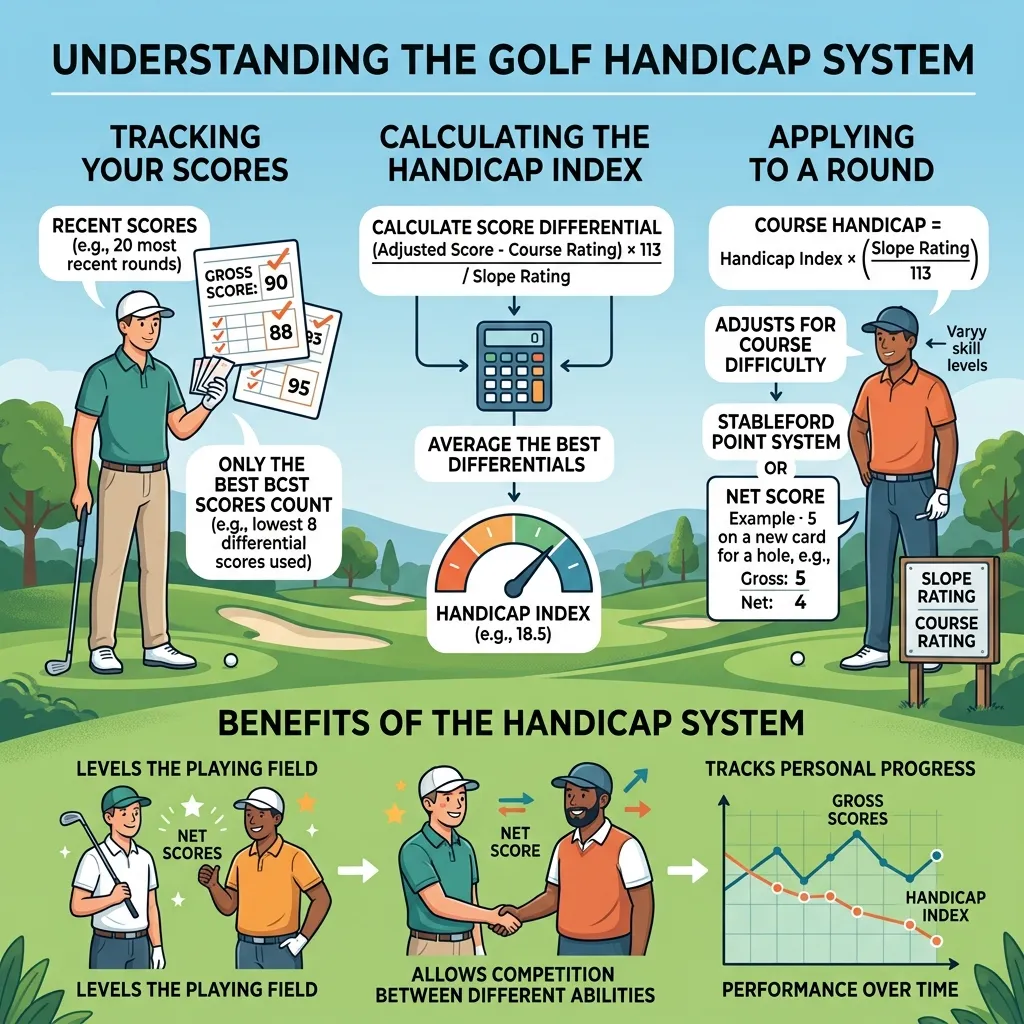
A golf handicap is a number that represents your playing ability. The lower the number, the better the golfer. The whole point of the system is to level the playing field, so a weekend warrior can compete fairly against a scratch golfer.
The official measure used today is the handicap index, which was standardized worldwide under the World Handicap System (WHS) in 2020. Your handicap index is calculated using the best 8 score differentials from your most recent 20 rounds. Each differential accounts for the difficulty of the course you played, measured by its Course Rating and Slope Rating.
Here’s why that matters: shooting 90 on an easy course isn’t the same as shooting 90 on a brutal championship layout. The handicap system adjusts for this, so your index reflects your true potential rather than just your raw scores.
When you actually play a round, your handicap index gets converted into a course handicap—the number of strokes you receive on that specific course. This makes head-to-head matches fair, no matter the venue.
What does handicap index mean for everyday golfers?
For most recreational players, your handicap index is a snapshot of your potential ability on a good day—not your average. The system intentionally rewards your better rounds. So if your handicap is 15, it doesn’t mean you shoot 15 over par every time. It means that on your stronger rounds, you’re playing at roughly that level.
This is a key point many beginners misunderstand. Your handicap reflects what you’re capable of when things click, which is why your typical score often runs a few strokes higher than your handicap suggests.
Golf handicap levels explained: low, mid, and high
Golfers are generally sorted into three broad categories based on their handicap index. While there’s no single official cutoff, these ranges are widely accepted among players and instructors:
- Low handicap: 0 to 9 (including scratch golfers at 0 or below)
- Mid handicap: 10 to 20
- High handicap: 21 and above
Let’s look at what each group looks like in practice.
Low handicap golfers
Low handicappers are skilled players who consistently break 80 or shoot in the low 80s. They have reliable swings, strong course management, and a sharp short game. A scratch golfer—someone with a handicap of 0—plays at or near par on most rounds. Only a small percentage of golfers ever reach this level.
Mid handicap golfers
Mid handicappers sit in the sweet spot of recreational golf. They’ve moved past the inconsistency of their early days and can put together solid rounds, but they still battle the occasional blow-up hole. More on this group below.
High handicap golfers
High handicappers are often newer players or those who play less frequently. They’re still building consistency and may struggle with fundamentals like ball striking and putting. Many high handicappers shoot in the upper 90s and above.
What is considered a mid handicap golfer?
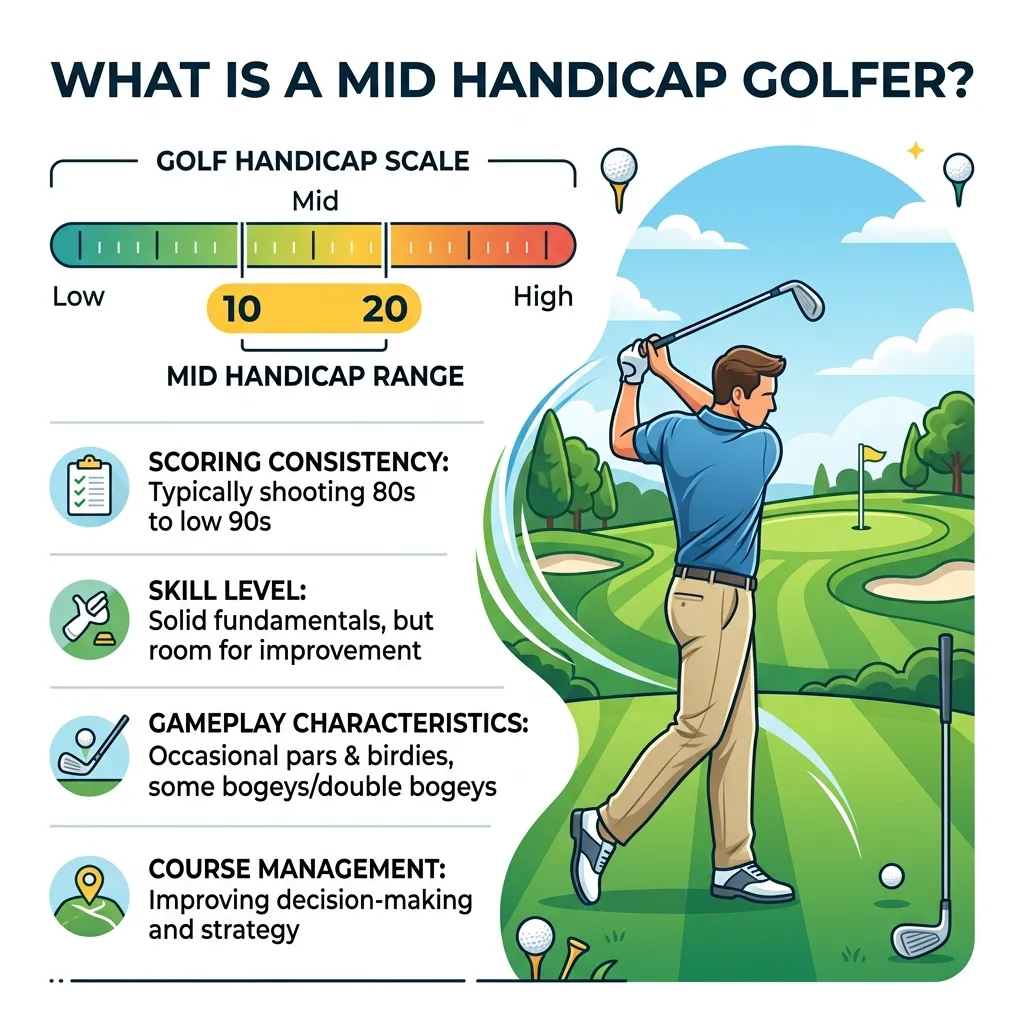
A mid handicap golfer is a player with a handicap index roughly between 10 and 20. These golfers have a dependable swing, understand the basics of course strategy, and can usually keep the ball in play. The defining trait of a mid handicapper is consistency—not perfection.
If you’re a mid handicapper, you’ve likely got a few reliable clubs in your bag and can produce a string of pars. But you also know the frustration of a triple bogey appearing out of nowhere. That mix of capability and unpredictability is exactly what separates mid handicappers from the players above and below them.
What score is a mid handicap in golf?
On a standard par-72 course, a mid handicapper typically shoots somewhere between 82 and 92. The lower end of that range (around 82-85) edges toward the low-handicap territory, while the higher end (closer to 90-92) borders on high-handicap play.
A useful benchmark: most mid handicappers can break 90 fairly regularly but rarely break 80. Breaking 90 consistently is one of the clearest signs you’ve reached solid mid-handicap status.
What’s the difference between a beginner and a mid handicap golfer?
The gap between a beginner and a mid handicapper comes down to consistency, course management, and short-game skill. Here’s how they compare:
- Ball striking: Beginners often mishit shots—chunks, thin shots, and slices are common. Mid handicappers make clean contact far more often.
- Course management: Beginners frequently attempt risky shots that lead to big numbers. Mid handicappers play smarter, laying up and avoiding trouble.
- Short game: Beginners struggle around the greens, while mid handicappers can chip and putt well enough to save par occasionally.
- Scoring: Beginners might shoot well over 100, while mid handicappers reliably score in the 80s.
The transition from beginner to mid handicapper usually takes consistent practice and time spent on the course. It’s less about adding distance and more about eliminating the disaster holes that wreck a scorecard.
What is the average golf handicap for men and women?
Knowing the averages helps put your own game in perspective. According to data from the United States Golf Association (USGA), the average handicap index breaks down roughly as follows:
- Average male handicap index: around 14
- Average female handicap index: around 28
This means the average male golfer falls squarely into the mid-handicap range, while the average female golfer sits in the high-handicap category. These figures reflect golfers who maintain an official handicap, so casual players who don’t track their scores aren’t included.
It’s worth remembering that averages don’t tell your whole story. Plenty of factors—how often you play, your physical fitness, access to coaching, and practice time—influence where you land.
How can mid handicappers lower their scores?
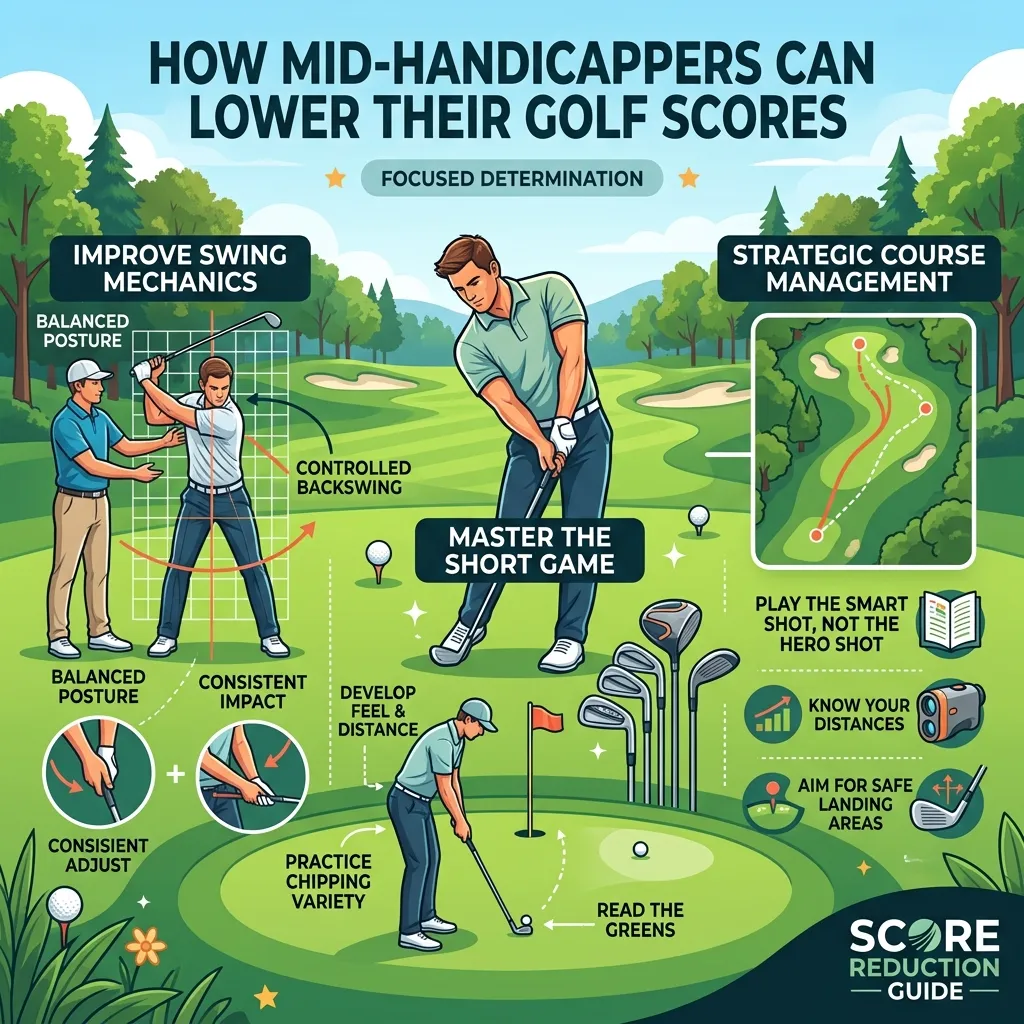
Reaching the mid-handicap level is a real accomplishment, but most players want to keep improving. The good news? Mid handicappers often have the most room to grow with focused effort. Here are practical tips to shave strokes off your game.
Sharpen your short game
Roughly 60% of golf shots happen within 100 yards of the green. If you want to lower your scores fast, dedicate practice time to chipping, pitching, and putting. Getting up and down more often turns potential double bogeys into pars and bogeys.
Improve your course management
Many mid handicappers lose strokes by making poor decisions, not poor swings. Aim for the center of greens instead of attacking tucked pins. Lay up when a hazard is in play. Choose the smart shot over the hero shot. Playing within your abilities often saves more strokes than any swing change.
Eliminate the big numbers
A single double or triple bogey can erase several good holes. Track your rounds and identify what causes your blow-up holes—is it tee shots into trouble, three-putts, or penalty strokes? Once you spot the pattern, you can adjust your strategy to avoid it.
Practice with purpose
Hitting balls aimlessly at the range does little for your scores. Instead, practice with specific targets and simulate on-course situations. Work on the shots that give you the most trouble rather than the ones you already hit well.
Get fitted for the right equipment
Clubs suited to your swing can make the game easier. Game-improvement irons, a forgiving driver, and a putter that fits your stroke can all help mid handicappers find more consistency. Consider a professional fitting if you haven’t had one.
Take a few lessons
Even a handful of sessions with a qualified instructor can fix flaws you can’t see yourself. A coach can identify swing faults, correct your setup, and give you a clear practice plan—accelerating your progress far faster than guessing on your own.
Where you stand—and where you’re headed
A mid handicap puts you in the company of millions of golfers who’ve worked hard to reach a respectable, consistent level of play. With a handicap index between 10 and 20, you’ve built the fundamentals that separate you from beginners, and you’re well-positioned to keep climbing toward single digits.
The path forward is clear: tighten up your short game, make smarter decisions on the course, and cut out the disaster holes. Track your rounds, practice with intention, and consider getting professional guidance to speed things along.
Your next step? Head out, post a few scores, and watch your handicap index tell the story of your improvement. The single-digit club is closer than you think.
Frequently asked questions
Is a 15 handicap good in golf?
Yes, a 15 handicap is considered good for a recreational golfer. It places you squarely in the mid-handicap range and is right around the average for male golfers who maintain an official handicap. A 15 handicapper typically breaks 90 on most rounds and plays a solid all-around game.
What percentage of golfers are mid handicappers?
Mid handicappers make up the largest segment of golfers who maintain an official handicap. Since the average male handicap index sits around 14 and falls within the 10-to-20 range, a substantial portion of tracked players fall into the mid-handicap category.
How long does it take to go from mid to low handicap?
The timeline varies based on practice and natural ability, but moving from a mid to a low handicap often takes one to several years of dedicated effort. Improvement tends to slow as you get better, so each stroke gets harder to shave off. Focused short-game practice and course management usually speed up the process.
What’s the difference between a handicap index and a course handicap?
Your handicap index is a portable number representing your overall ability, calculated from your recent rounds. A course handicap converts that index into the actual number of strokes you receive on a specific course, accounting for that course’s difficulty. You use your course handicap when playing a particular round.
Can a mid handicapper break 80?
A mid handicapper can occasionally break 80, especially those at the lower end of the range (around 10-12). However, breaking 80 consistently usually signals a move into low-handicap territory. For most mid handicappers, breaking 80 is a stretch goal rather than a regular occurrence.
What is a Mid Handicap in Golf?
A Mid Handicap in Golf refers to players with a handicap index between 10 and 20 who have decent consistency but still make occasional mistakes.
What score does a mid handicap golfer usually shoot?
Most mid handicappers shoot between 82 and 92 on a standard par-72 course.
Is a 15 handicap considered a Mid Handicap in Golf?
Yes, a 15 handicap falls right in the middle of the Mid Handicap in Golf range and is considered average to good among recreational players.
How does a Mid Handicap in Golf differ from a beginner?
Mid handicappers have better consistency, course management, and short-game skills compared to beginners who often shoot over 100.
What is the average handicap for golfers?
The average male golfer is around a 14 handicap, which is within the Mid Handicap in Golf range.
Can a Mid Handicap in Golf break 80?
Yes, but only occasionally. Consistent scores below 80 usually belong to low-handicap players.
How do you improve from a Mid Handicap in Golf?
Focus on short game practice, smarter course management, and eliminating big mistakes or penalty shots.
What are common mistakes for mid handicappers?
Typical issues include inconsistent driving, three-putts, and poor decision-making under pressure.
How long does it take to leave the Mid Handicap in Golf range?
It can take months to years depending on practice, coaching, and how often you play.
Why is understanding Mid Handicap in Golf important?
It helps golfers set realistic expectations, track progress, and focus on the right areas for improvement.
