

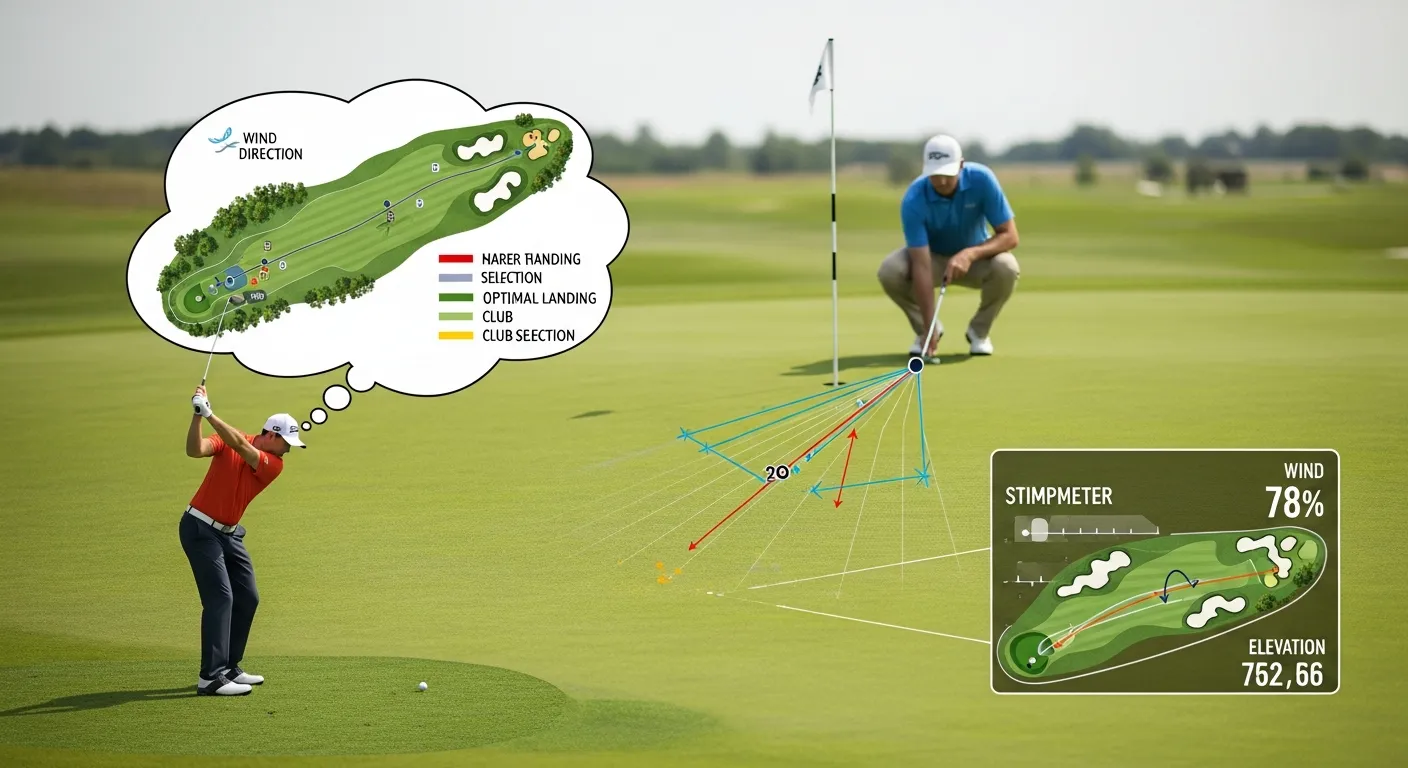
Want to lower your scores without changing your swing? A solid golf strategy transforms how you navigate the course. Let us explore techniques that instantly elevate your game.
This guide breaks down essential course management and precise green reading tactics. You will learn to make smarter decisions, avoid costly errors, and read putts like a professional. Implement these actionable insights to lower your handicap and enjoy more consistent rounds.
The Foundation of a Winning Golf Strategy

Many players obsess over swing mechanics while completely ignoring how they navigate the course. A phenomenal golf strategy is the ultimate equalizer. It allows a player with average mechanics to consistently beat someone with a beautiful swing but terrible decision-making skills.
Course management and green reading form the twin pillars of this approach. When you combine spatial awareness with calculated risk-taking, you drastically reduce big numbers on your scorecard. Think of your approach to the game the way businesses approach Brand Strategy—you need a clear plan, an understanding of your environment, and the discipline to execute your vision.
Understanding Your Personal Yardages
You cannot execute a strong golf strategy if you do not know how far you hit each club. Many amateurs base their club selection on their absolute best shots rather than their average distances.
To map your yardages accurately:
- Hit 10 balls with each club at the driving range.
- Discard the longest and shortest shots.
- Calculate the average distance of the remaining eight shots.
- Record both your carry distance and your total distance (carry plus roll).
When you know your true average carry distance, you eliminate the guesswork. You stop coming up short in front bunkers and start hitting more greens in regulation.
Playing the Percentages on the Tee
The tee box sets the tone for the entire hole. Most amateurs automatically pull the driver on every par 4 and par 5. A disciplined golf strategy requires you to evaluate the hole before reaching into your bag.
Ask yourself these questions before teeing off:
- Where is the worst trouble on this hole?
- What distance leaves me the most comfortable approach shot?
- Does the fairway narrow at my driver landing zone?
If hitting a 3-wood or hybrid keeps you short of water hazards and leaves you a full 8-iron to the green, that is the superior play. Position always beats pure distance.
Advanced Course Management Techniques
Course management means managing your mistakes. Even professional golfers only hit a few perfect shots per round. The secret to an effective golf strategy lies in ensuring your bad shots do not ruin your scorecard.
The Art of the Miss
You must plan for failure. When evaluating your approach shot, identify the “safe miss” area around the green. If a pin is tucked close to a deep right bunker, the safest play targets the center or left side of the green.
By aiming away from the worst hazards, you guarantee that a slight mishit still leaves you with a manageable chip or a long putt, rather than a penalty stroke or a near-impossible bunker save.
Managing Par 5s
Par 5s offer excellent scoring opportunities, provided you use a smart golf strategy. Going for the green in two shots is tempting, but it often brings massive risk.
Instead, work backward from the green. If your favorite distance to hit a wedge is 100 yards, and you have 260 yards left for your second shot, do not hit a 240-yard 3-wood into the narrowest part of the fairway. Hit a 160-yard iron safely into the widest part of the fairway, leaving exactly 100 yards for your third shot. This heavily increases your chances of making birdie or an easy par.
Strategy Comparison: Aggressive vs. Conservative
|
Scenario |
Aggressive Strategy |
Conservative Strategy |
Ideal Golf Strategy |
|---|---|---|---|
|
Pin tucked near water |
Aim directly at the flag. |
Aim at the middle of the green. |
Aim at the middle of the green to ensure a two-putt par. |
|
Narrow fairway |
Hit driver to maximize distance. |
Hit iron or hybrid to find the short grass. |
Club down to guarantee fairway placement. |
|
Tree trouble |
Attempt a high-risk hero shot through a tiny gap. |
Pitch out sideways to the fairway. |
Pitch out, take your medicine, and rely on your wedge game. |
Mini-Conclusion: Excellent course management does not mean playing timidly. It means taking calculated risks only when the potential reward heavily outweighs the penalty for failure.
Mastering Green Reading

Hitting the green is only half the battle. Once you arrive, your golf strategy shifts to green reading. Reading greens correctly requires a mix of physics, observation, and geometry.
Finding the Fall Line
Every slope on a green has a “fall line”—the straightest path water would take if poured on the green. Finding this line dictates how your putt will break.
Walk to the low side of the hole and look up toward your ball. This vantage point reveals the general tilt of the green much better than looking from the ball to the hole. Once you identify the overall slope, you can determine if your putt is uphill, downhill, or breaking side-to-side.
Evaluating Grain and Grass Type
The type of grass and the direction it grows (the grain) heavily influence the speed and break of your putt.
- Shiny grass: This means you are putting down-grain. The putt will be significantly faster and roll out further.
- Dull or dark grass: This indicates you are putting into the grain. The putt will be slower and require a firmer stroke.
- Cup edges: Look at the edge of the hole. The side where the grass looks ragged or slightly worn is the direction the grain is pulling.
Pace vs. Line
Pace dictates the line. A ball hit firmly takes less break, while a ball rolling gently takes more break. Your golf strategy on the greens must unify speed and direction.
Always visualize the last three feet of the putt. Imagine the ball dying precisely at the front edge of the cup. When you focus on the correct pace, your brain naturally adjusts to the necessary break.
Expert Insights and Pro Tips
To refine your golf strategy, adopt these expert habits:
- Divide the green into quadrants: Never aim blindly at the pin. Aim for the specific quadrant of the green that leaves an uphill putt.
- Track your stats: You cannot improve what you do not measure. Track your fairways hit, greens in regulation, and putts per round to identify weaknesses in your strategy.
- Establish a pre-shot routine: A consistent routine calms your nerves and locks in your focus. Do the exact same sequence of practice swings and alignment checks before every shot.
- Use the tee box width: If there is trouble on the right side of the fairway, tee your ball up on the far right side of the tee box. This forces you to aim diagonally away from the hazard, opening up the safest landing zone.
Common Mistakes to Avoid
Even seasoned players ruin their scores by making fundamental strategic errors. Avoid these pitfalls:
- Following a bad shot with a stupid shot: After hitting into the trees, do not attempt a miraculous recovery. Pitch out to the fairway. Compounding errors destroys scorecards.
- Under-clubbing on approach shots: Most amateurs leave approach shots short. When in doubt, take one extra club and swing smoothly.
- Ignoring the wind: Wind affects the golf ball much more than you think. Always assess the wind direction at the canopy level of the trees, not just at ground level.
- Forgetting elevation changes: Add one club for every 10 yards of uphill elevation. Subtract one club for every 10 yards downhill.
The Mental Side of Golf Strategy
Your mental state heavily impacts your tactical decisions. Golf strategy fails the moment frustration takes over.
Maintain emotional control by staying in the present moment. You cannot change the drive you just sliced into the woods. You can only control the recovery shot in front of you. Build a resilient mindset by focusing entirely on the process of the shot rather than the outcome. Commit fully to the club and the target you selected. Doubt causes tension, and tension ruins golf swings.
Conclusion
Implementing a disciplined golf strategy instantly elevates your performance on the course. By mastering course management, playing the percentages, and refining your green reading skills, you give yourself the ultimate competitive advantage. Stop wasting strokes on poor decisions. Start plotting your way around the course today and watch your handicap drop significantly.
FAQs
What is the most important element of golf strategy?
The most critical element is course management, specifically knowing your true distances and avoiding high-risk shots that lead to penalty strokes. Playing away from trouble saves more strokes than hitting spectacular recovery shots.
How do I stop slicing my driver using strategy?
While a slice is a swing flaw, you can manage it strategically by teeing up on the right side of the tee box and aiming down the left side of the fairway. This gives your ball the maximum amount of room to curve safely into play.
When should I use a 3-wood instead of a driver off the tee?
Use a 3-wood when the fairway narrows at your driver landing distance, when severe hazards line the fairway, or when a shorter drive leaves you with a preferred yardage for your approach shot.
How does wind affect my golf strategy?
Wind drastically alters club selection. A headwind magnifies the spin on the ball, causing it to fly higher and shorter. Take extra clubs and swing easier into the wind to keep the flight low. Ride the wind by aiming accordingly on crosswinds.
What is the best way to practice green reading?
Practice green reading by walking around the hole to find the fall line. Roll balls by hand to see how slopes affect the speed and curve. This helps train your eyes to recognize subtle breaks without the distraction of using a putter.
Should I always aim for the pin?
No. Aiming for the pin is a common amateur mistake. You should aim for the center of the green or the safest side of the pin to guarantee a putt. Only attack the pin if you hold a short wedge and the hazard risk is low.
How do elevation changes impact club selection?
A general rule is to adjust one club for every 10 yards of elevation change. If the green is 10 yards uphill, take one more club. If it sits 10 yards downhill, take one less club.
What does “taking your medicine” mean in golf strategy?
Taking your medicine means accepting a bad situation and playing the safest possible shot to get back in position. Instead of trying a risky shot through trees, you pitch out to the fairway to guarantee a chance at bogey rather than a triple bogey.
How do I read grain on a putting green?
Look at the color of the grass and the edges of the cup. Shiny, light green grass means the grain is growing away from you (faster putt). Dark green grass means the grain is growing toward you (slower putt).
How do I build a reliable pre-shot routine?
Keep it simple and repeatable. Stand behind the ball to pick your target, take one practice swing to feel the required distance, step up to the ball, align your clubface, set your stance, look at the target once more, and pull the trigger. Do this on every single shot.
