

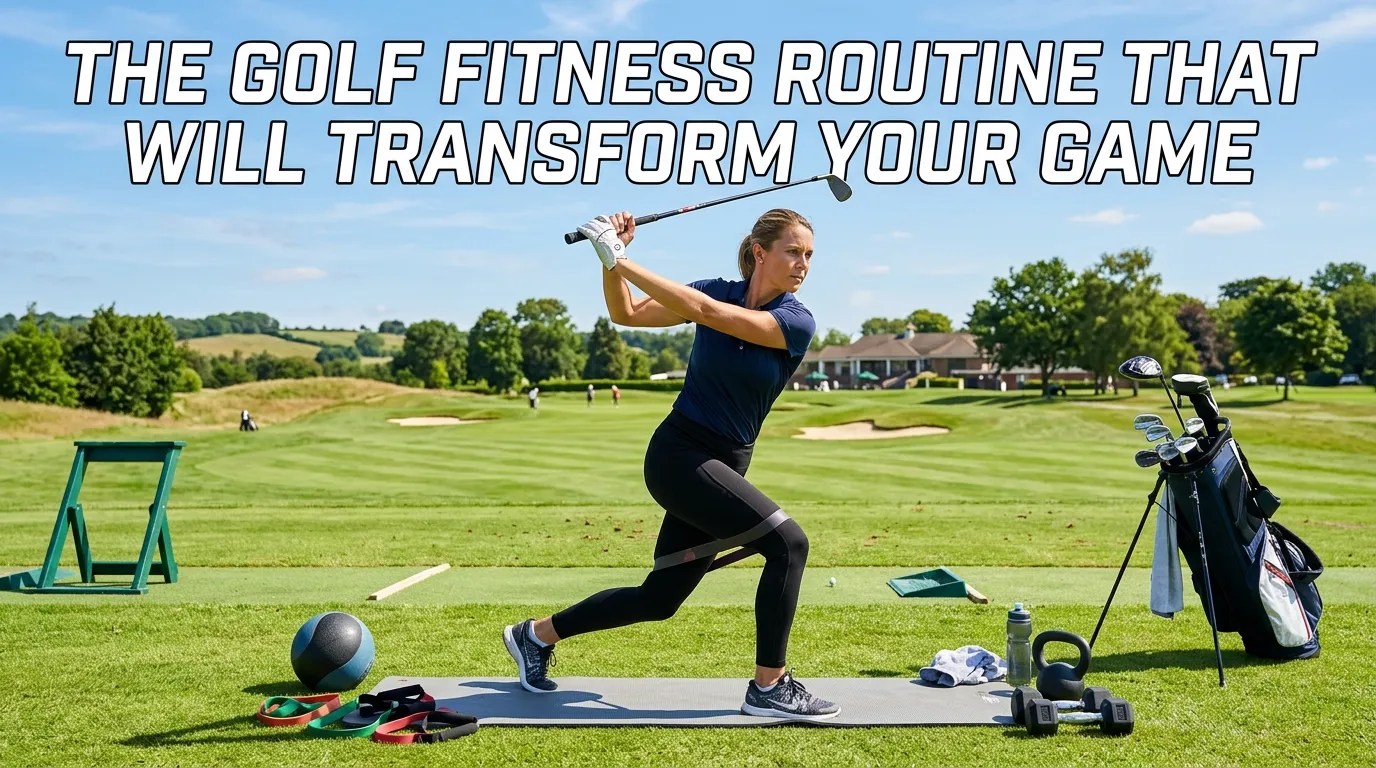
A golf fitness routine combines strength training, mobility work, flexibility exercises, and conditioning to improve swing power, consistency, and injury prevention. By following a structured golf-specific training program, players can increase distance, enhance balance and posture, reduce fatigue during rounds, and maintain long-term performance on and off the course.
What Does a Complete Golf Workout Program Look Like?
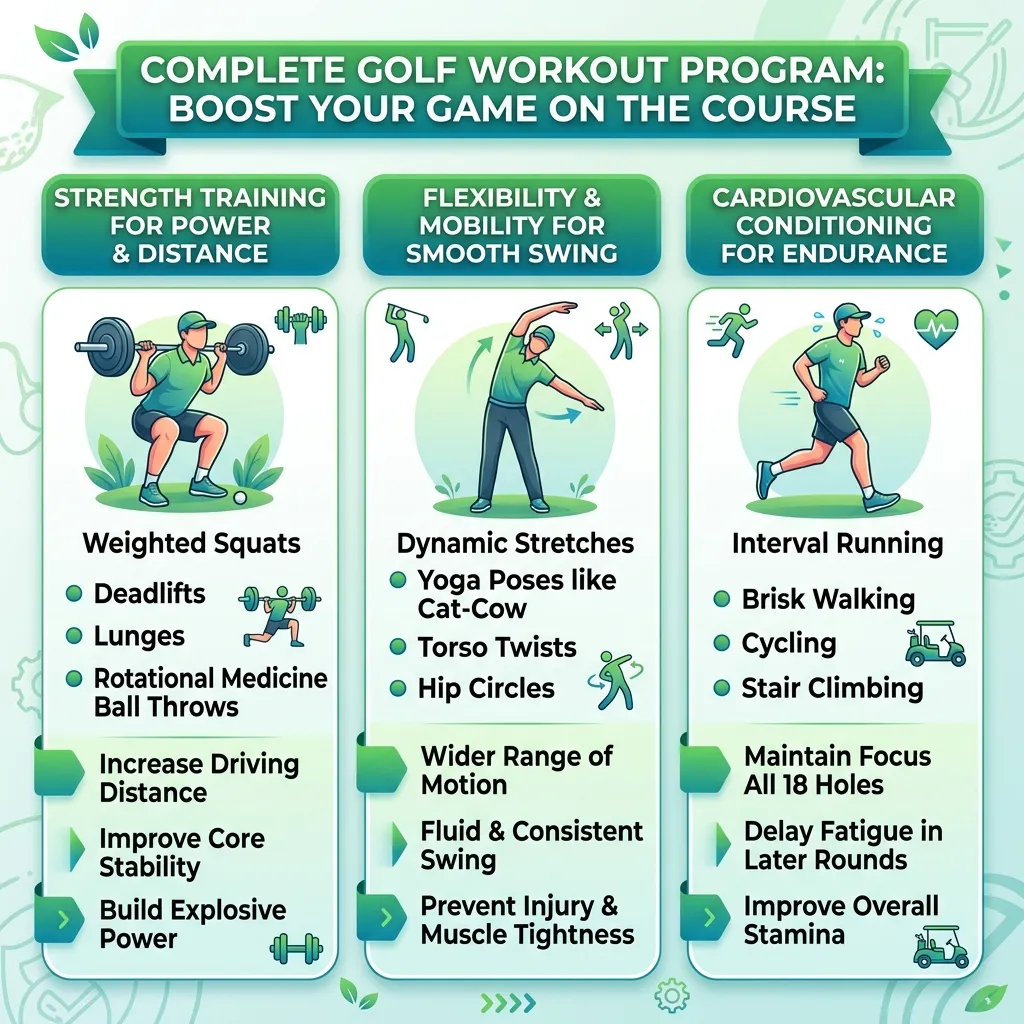
A well-designed golf workout program addresses four core pillars: strength, flexibility, conditioning, and mobility. Each one plays a distinct role in your game.
- Strength builds the muscular power behind your swing
- Flexibility allows your body to complete a full, unrestricted range of motion
- Conditioning keeps your energy levels consistent across all 18 holes
- Mobility ensures your joints can move efficiently under load
Most recreational golfers focus on one or two of these at most. The players who see real, measurable improvement are the ones who address all four consistently. Aim to train three to four times per week, dedicating different sessions to different pillars—or combining them in a single well-structured workout.
How Does Golf Strength Training Improve Your Swing?
Golf strength training targets the muscles that drive power, stability, and control through the entire swing sequence. These include the glutes, hamstrings, core, lats, forearms, and shoulders.
Key exercises to include:
- Romanian Deadlifts: Develop posterior chain strength, which is critical for maintaining your posture and generating hip drive at impact
- Goblet Squats: Build leg strength and improve the hip hinge pattern that anchors a powerful swing
- Cable Rotations: Train the rotational muscles of the core and obliques in a golf-specific movement pattern
- Dumbbell Rows: Strengthen the lats and upper back, supporting a consistent, controlled downswing
- Farmer’s Carries: Improve grip strength and total-body stability—both underrated factors in golf performance
Train strength two days per week with moderate weight and controlled movement. Heavy lifting has a place in golf fitness, but technical execution matters more than the weight on the bar.
What Are the Best Golf Flexibility Exercises for a Full Swing?
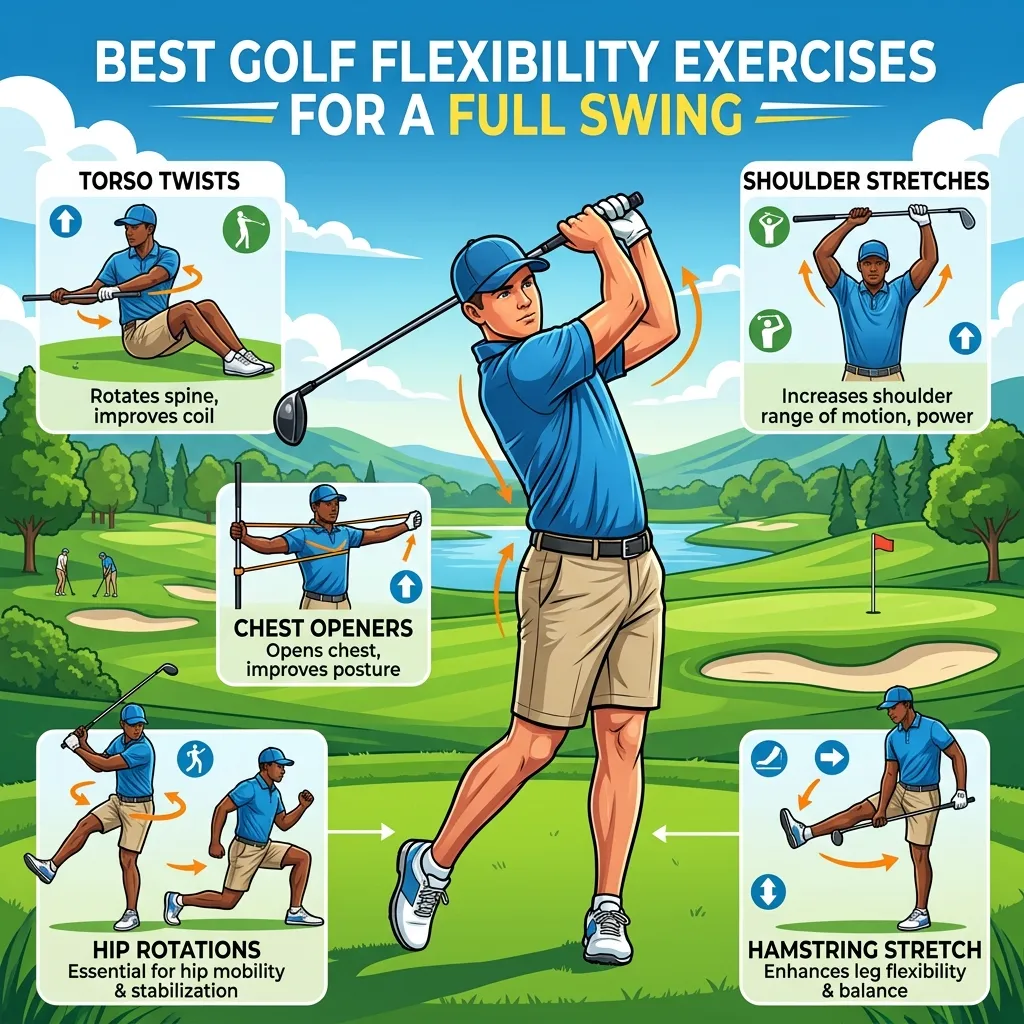
Flexibility directly affects how far back you can take the club and how freely your body rotates through impact. Tight hips, hamstrings, and thoracic spine are among the most common limiters of swing range in recreational golfers.
These flexibility exercises are worth adding to your daily routine:
Hip Flexor Stretch
Kneel on one knee in a lunge position and drive your hips gently forward. Hold for 30 to 45 seconds per side. This counteracts the tightness caused by long periods of sitting and restores full hip extension.
Seated Hamstring Stretch
Tight hamstrings tilt the pelvis posteriorly, which flattens your lumbar spine and disrupts your golf posture. Stretch them daily, especially before and after rounds.
Chest and Shoulder Opener
Stand in a doorframe with your arms at 90 degrees and gently press forward. This opens the anterior shoulder and chest—muscles that tend to tighten from desk work—and improves shoulder turn on the backswing.
Thoracic Rotation Stretch
Sit on the ground with your legs crossed, place one hand behind your head, and rotate your upper back as far as comfortable. Thoracic mobility is one of the most overlooked components of a powerful, repeatable golf swing.
Flexibility work doesn’t require a gym. Five to ten minutes of daily stretching—done consistently—will produce noticeable results within a few weeks.
How Should You Structure a Golf Conditioning Routine?
Golf conditioning is about building the cardiovascular endurance and muscular stamina to perform at a high level across a full round—typically four to five hours on your feet, often in heat, often with a bag on your back.
A golf conditioning routine should include:
- Aerobic base training: Brisk walking, cycling, or light jogging for 30 to 45 minutes, two to three times per week. Walking the course itself counts here.
- Circuit training: Combine bodyweight or light resistance exercises with minimal rest to elevate heart rate while building muscular endurance simultaneously
- Tempo intervals: Short bursts of higher-intensity effort followed by active recovery. These replicate the physical demands of a round—repeated short bouts of exertion separated by walking
Conditioning work also improves focus and decision-making late in a round, when fatigue starts affecting concentration. Many golfers notice their score deteriorates most on the back nine—and a lack of physical conditioning is often the reason.
What Is Golf Performance Training and Who Is It For?
Golf performance training is a more structured, progressive approach to fitness that aligns training goals directly with on-course results. It’s used extensively by touring professionals and is increasingly accessible to amateur players.
The key distinction between general fitness and golf performance training is specificity. Performance training programs are designed around:
- Your current physical limitations (identified through a movement screen)
- The specific demands of the golf swing
- A periodized structure that builds toward peak performance at key times of year
Golf performance training often incorporates tools like resistance bands, medicine balls, TRX suspension trainers, and rotational power exercises. It’s suitable for any golfer who wants measurable improvement, not just general health benefits.
Why Are Golf Mobility Exercises Different from Flexibility Training?
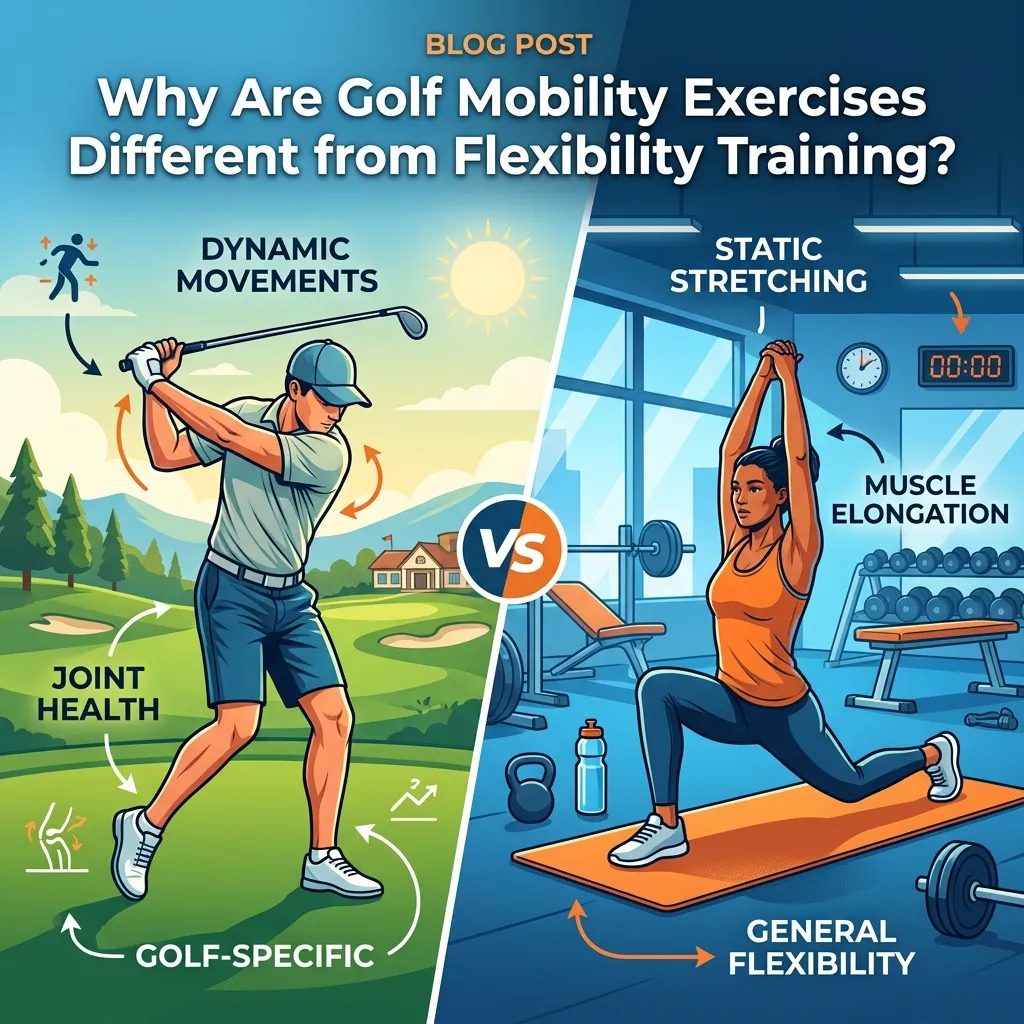
Mobility and flexibility are often used interchangeably, but they’re not the same thing. Flexibility refers to a muscle’s ability to lengthen passively. Mobility is the ability to move a joint actively through its full range of motion under control.
For golf, mobility matters more than flexibility alone. You need your hips, thoracic spine, and shoulders to move freely and powerfully—not just stretch when pushed.
Key Golf Mobility Exercises
90/90 Hip Stretch: Sit on the floor with both legs bent at 90 degrees. This targets internal and external hip rotation—two of the most important movements in a golf swing.
Cat-Cow with Rotation: On hands and knees, move through spinal flexion and extension while adding rotation. Excellent for warming up the thoracic spine before a round or training session.
Half-Kneeling Hip Flexor with Reach: This combines hip mobility with thoracic extension, targeting two common restriction points simultaneously.
Ankle Circles and Dorsiflexion Drills: Ankle mobility is underrated in golf. Poor ankle dorsiflexion limits squat depth and hip drive, both of which affect weight transfer in the swing.
Spend five to ten minutes on mobility work before every round and training session. It takes minimal time but pays significant dividends in swing freedom and injury prevention.
How Do You Build Golf Core Strength for More Power and Control?
Core strength is the foundation of every efficient golf swing. The core isn’t just your abs—it includes the deep stabilizers of the lumbar spine, the obliques, the glutes, and the muscles of the hip complex.
A strong core allows you to:
- Transfer energy efficiently from the ground through your body to the club
- Maintain posture through a full swing without early extension or loss of spine angle
- Decelerate the club safely after impact, reducing strain on the lower back and shoulders
Best Golf Core Strength Exercises
Pallof Press: A cable or band anti-rotation exercise that trains the core to resist unwanted movement—exactly what it needs to do through impact.
Dead Bug: Lying on your back, extend opposite arm and leg while keeping your lower back pressed to the floor. Builds deep core stability in a safe, controlled position.
Side Plank with Hip Abduction: Targets the lateral core and hip abductors, which stabilize the pelvis throughout the swing.
Rotational Medicine Ball Slams: Train explosive rotational power in a movement that closely mimics the mechanics of a golf swing.
Aim to include core work three times per week. Even ten minutes per session is enough to build meaningful strength over time.
What Are the Most Effective Golf Swing Fitness Exercises?
Golf swing fitness exercises replicate the biomechanical demands of the swing itself. These movements bridge the gap between the gym and the course.
Band Pull-Aparts: Improve shoulder stability and scapular control, reducing the risk of the leading shoulder breaking down early in the backswing.
Lateral Band Walks: Activate the glute medius, which plays a critical role in maintaining hip stability during the weight transfer.
Single-Leg Romanian Deadlift: Challenges balance, hip stability, and posterior chain strength all at once—making it one of the most golf-specific exercises available.
Rotational Cable Chop and Lift: Trains the full diagonal pattern of the golf swing from a cable machine. Move from low to high (chop) and high to low (lift) to address both backswing and downswing mechanics.
These exercises don’t require advanced athletic ability. Start light, focus on control, and add resistance gradually.
How Can Golf Injury Prevention Exercises Protect Your Body?
Golf-related injuries are more common than most players expect. The lower back, shoulders, elbows, and wrists are the most frequently affected areas—and most injuries are preventable with proper physical preparation.
Lower Back Protection: Strengthen the glutes, core, and hip flexors to reduce the load placed on the lumbar spine during rotation. The deadbug, glute bridge, and McGill Big Three (curl-up, side plank, bird dog) are widely used by physical therapists for this purpose.
Shoulder Health: Rotator cuff strengthening exercises—using light resistance bands—protect the shoulder joint from the repetitive stress of thousands of swings per year.
Elbow and Wrist Care: Forearm strengthening exercises and wrist mobility drills reduce the risk of golfer’s elbow (medial epicondylitis), one of the most common overuse injuries in the sport.
Proper Warm-Up: A dynamic warm-up before every round—not just a few practice swings—significantly reduces injury risk. Include leg swings, arm circles, torso rotations, and light chip shots before moving to full swings.
Building a Weekly Golf-Specific Fitness Training Schedule
Here’s a sample weekly structure that integrates all the components covered above:
- Monday: Golf strength training (lower body focus) + core
- Tuesday: Flexibility and mobility (30 minutes)
- Wednesday: Golf conditioning (circuit or tempo intervals)
- Thursday: Golf strength training (upper body and rotational power)
- Friday: Mobility and golf swing fitness exercises
- Saturday: Round of golf (with dynamic warm-up)
- Sunday: Rest or light walking
Adjust based on your schedule and current fitness level. The goal is consistency over intensity—three structured sessions per week, done reliably, will outperform an aggressive schedule that leads to burnout or injury.
Take Your Game Off the Course
Golf Fitness Routine is no longer just for tour professionals. A structured, golf-specific training routine is accessible to any player—and the returns on that investment show up directly on the scorecard.
Start with the basics: build your mobility and flexibility foundation, add two strength sessions per week, and layer in conditioning as your fitness improves. Track your progress, listen to your body, and remember that the goal isn’t to become a gym athlete—it’s to become a better golfer.
The strongest version of your game is built between rounds, not just during them.
Frequently Asked Questions
How often should golfers work out to see improvement?
Three to four sessions per week is the sweet spot for most amateur golfers. This allows enough training stimulus to build strength and mobility while leaving adequate time for recovery. Even two focused sessions per week will produce noticeable results over a 6 to 8 week period.
Can golf fitness training add distance off the tee?
Yes. Golf fitness training—particularly strength training and rotational power work—directly increases clubhead speed, which is the primary driver of distance. Improving hip mobility and core strength can add meaningful yards without any changes to swing mechanics.
What is the most important muscle group for golf?
The glutes are widely considered the most important muscle group for golf performance. Strong glutes support hip drive, rotational power, and lower back health—all of which are central to an effective, injury-free swing.
How long does it take to see results from a golf fitness routine?
Most golfers notice improved energy, mobility, and swing feel within four to six weeks of consistent training. Measurable strength and power gains typically follow after eight to twelve weeks.
Is golf fitness training suitable for older players?
Absolutely. Golf fitness training is highly adaptable and especially beneficial for older players, who tend to lose mobility and muscle mass with age. Low-impact strength exercises, daily flexibility work, and mobility drills can meaningfully improve swing performance and reduce injury risk for players in their 50s, 60s, and beyond.
What’s the difference between golf mobility exercises and a standard stretching routine?
A standard stretching routine improves passive flexibility—how far a muscle can lengthen when relaxed. Golf mobility exercises train active range of motion, meaning your body can control movement through the full range under load. For golf, active mobility is more directly applicable to swing mechanics than passive flexibility alone.
