


The World Amateur Golf Ranking (WAGR) is the official global ranking system for amateur golfers, updated weekly based on points earned at sanctioned tournaments worldwide. Rankings reflect performance over a rolling two-year period, with more recent results weighted more heavily.
Amateur golf has a ranking system just as sophisticated as the professional game—and for serious players, it matters enormously. A high WAGR position can open doors to major amateur championships, earn invitations to prestigious professional events, and even attract the attention of college recruiters and sponsors.
But how exactly does the system work? Which tournaments count? And who are the elite amateur golfers currently sitting at the top of the leaderboard? This guide covers everything you need to know about global amateur golf rankings, from the points system to the players worth watching.
What Is the World Amateur Golf Ranking (WAGR)?

The World Amateur Golf Ranking—commonly referred to as WAGR golf rankings—is the official system used to rank amateur golfers across the globe. Launched in 2007 and jointly administered by the R&A and the USGA, WAGR functions as the amateur equivalent of the Official World Golf Ranking (OWGR) used on the professional tours.
The ranking covers both men and women, with separate leaderboards maintained for each. Rankings are updated every Monday and reflect results from hundreds of sanctioned amateur golf tournaments played around the world.
WAGR is widely recognized by national golf federations, universities, and major championship organizers as the benchmark for measuring amateur golf excellence. For any serious amateur golfer with aspirations to compete at the highest level or transition to the professional game, a strong WAGR position is one of the most meaningful metrics available.
How Does the WAGR Points System Work?
The golf ranking points system behind WAGR is built on a rolling two-year model, meaning only results from the previous 104 weeks are counted. Within that window, more recent performances carry greater weight—an incentive structure that rewards consistency and current form rather than reputation alone.
Here’s how points are allocated:
- Tournament grade: Not all events are equal. WAGR assigns each sanctioned tournament a grade from 1 to 7 (with Grade 1 being the most prestigious), and the points on offer scale accordingly. Major amateur championships like the U.S. Amateur and The Amateur Championship sit at the top tier.
- Field strength: Points are also adjusted based on the quality of the field. A win at a tournament packed with highly ranked players will yield more points than a win at a weaker event.
- Finishing position: Points decrease progressively from the winner down through the field, with a cut-off point beyond which no points are awarded.
A player’s ranking is calculated by dividing their total points by the number of events played, provided they’ve entered the minimum number of tournaments required. This average-based approach means that quality consistently outweighs quantity—entering weak events just to pad results will not improve a ranking.
Which Amateur Golf Tournaments Award WAGR Points?
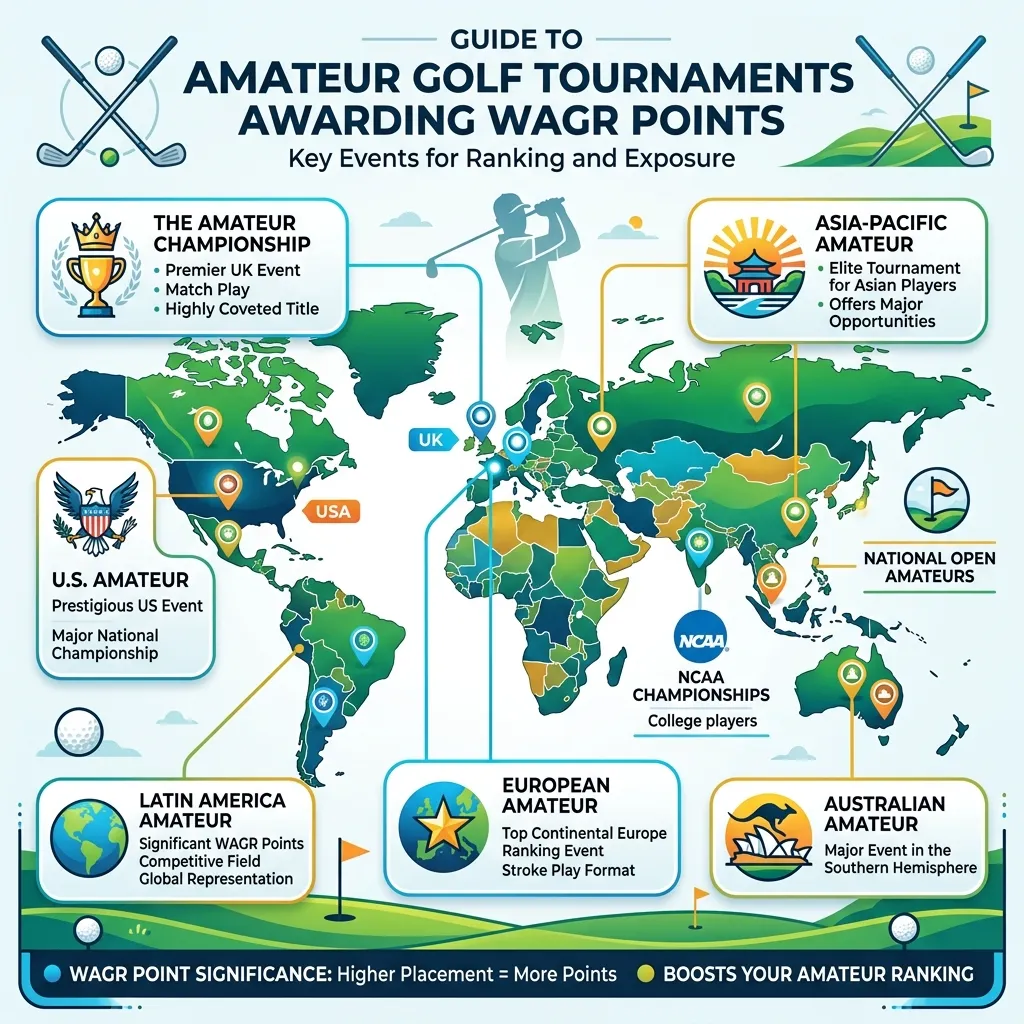
There are hundreds of WAGR-sanctioned amateur golf tournaments held annually across every continent. These range from nationally significant events to internationally recognized championships.
Some of the most points-rich events on the amateur golf calendar include:
- The Amateur Championship (R&A) — The oldest and most prestigious amateur golf event in the world, held annually in Great Britain and Ireland.
- U.S. Amateur Championship (USGA) — The premier amateur event in the United States, with a Grade 1 designation and significant WAGR points on offer.
- Asia-Pacific Amateur Championship — The top-ranked winner earns an invitation to The Masters and The Open Championship.
- Latin America Amateur Championship — The champion receives invitations to The Masters and The Open Championship.
- European Amateur Championship — A high-profile team and individual event offering strong WAGR points.
- Augusta National Women’s Amateur — One of the most prestigious events on the women’s amateur calendar.
- U.S. Women’s Amateur — The USGA’s flagship women’s amateur event.
Beyond these marquee events, players accumulate points through national opens, university competitions (including NCAA events in the U.S.), and regional championships. The breadth of the sanctioned schedule means that elite amateurs from every corner of the globe have pathways to build their rankings.
How to Access the Amateur Golf Leaderboard
The official WAGR rankings are published on the WAGR website (wagr.com) and updated each Monday following the conclusion of any sanctioned events. The site provides separate leaderboards for men and women, a searchable player database, and a full list of sanctioned tournaments with their assigned grades.
National golf federations—including the USGA, Golf Australia, Golf Canada, and others—also publish rankings and often maintain their own national amateur leaderboards, which draw from WAGR data.
For players looking to track their own standing or monitor competitors, the WAGR site is the definitive resource. Each player profile shows current ranking, points total, recent results, and a history of sanctioned tournament appearances.
Who Are the Top Amateur Golfers in the World Right Now?
The amateur golf leaderboard at the top end is fiercely competitive, regularly featuring players who are on the verge of turning professional. Historically, the list of former world number one amateurs reads like a who’s who of professional golf—Tiger Woods, Rory McIlroy, Jordan Spieth, Justin Rose, and Jon Rahm all held the top amateur ranking before going on to win major championships.
Currently, the top amateur golfers tend to emerge from strong college golf programs in the United States, elite national academies in Europe, and increasingly competitive programs in Asia and the Asia-Pacific region. While specific rankings shift weekly, players who consistently contend at Grade 1 and Grade 2 events are typically the ones who rise to the top of the amateur golf player rankings.
Countries with the strongest representation at the top of the global amateur golf rankings include the United States, England, Spain, Australia, Japan, South Korea, and Sweden—nations with deep infrastructure for player development and a high concentration of WAGR-sanctioned events.
Why Does the WAGR Matter for Amateur Golfers?

A strong WAGR position creates real, tangible opportunities that extend well beyond bragging rights. Here’s why the ranking carries genuine weight:
Invitations to Professional Majors
The relationship between the amateur world ranking and professional major championships is direct. Both The Masters and The Open Championship extend invitations to players ranked within the top 50 of the WAGR at prescribed qualifying dates. For an amateur golfer, this represents a rare chance to compete on the biggest stage in golf without surrendering amateur status.
College Recruitment in the United States
For juniors and younger amateurs eyeing Division I college golf programs, WAGR is one of the primary tools coaches use to evaluate talent. A strong ranking signals proven competitive performance at sanctioned events rather than just strong results on the local circuit.
Pathway to the Professional Game
Many professional tours and qualifying schools consider WAGR standing when granting exemptions or ranking players for entry lists. A player who has reached the top 50 of the world amateur golf rankings arrives at the professional level with a credible competitive record already established.
National Team Selection
Most national golf federations use WAGR as a key criterion when selecting teams for international competitions such as the Walker Cup, the Eisenhower Trophy, the Curtis Cup, and the Espirito Santo Trophy. A player outside the top 200 is unlikely to be seriously considered for national team duties at most federations.
How Do Amateur Golfers Improve Their WAGR Ranking?
Climbing the amateur golf leaderboard requires a deliberate tournament strategy. Simply playing more golf is not enough—the type and quality of events matters significantly.
Practical steps for improving a WAGR standing include:
- Targeting high-grade events: Focus on Grade 1 through Grade 3 tournaments where the points on offer are substantially higher than at local or regional events.
- Playing in strong fields: Because WAGR adjusts points for field strength, performing well in fields with many highly ranked players accelerates ranking gains more than winning weaker events.
- Maintaining consistency: The average-based calculation means that a run of strong results across several major events will outperform a single exceptional performance followed by several poor ones.
- Qualifying for invitational events: Many top-tier amateur events are invitation-only, meaning players must first establish themselves at lower-grade events to earn entry.
For junior golfers transitioning into elite amateur competition, starting with nationally sanctioned events and building a track record before targeting international competitions is the most sustainable path upward.
Frequently Asked Questions
What is the World Amateur Golf Ranking (WAGR)?
WAGR is the official global ranking system for amateur golfers, administered jointly by the R&A and the USGA. Rankings are updated weekly and based on points earned at sanctioned tournaments over a rolling two-year period.
How often are WAGR rankings updated?
Rankings are updated every Monday, reflecting results from any sanctioned events completed during the previous week.
How many amateur golf tournaments are sanctioned by WAGR?
Hundreds of tournaments across the world are WAGR-sanctioned each year, spanning all six continents. The full list is published on the official WAGR website.
Can junior golfers appear in the WAGR?
Yes. Junior golfers who compete in WAGR-sanctioned events—including many national junior championships—can accumulate points and appear in the rankings. Some events are designated specifically for juniors and carry their own grade designations.
Does a high WAGR ranking guarantee entry into professional majors?
Not automatically, but top-50 WAGR-ranked players at specific qualifying dates are eligible for invitations to The Masters and The Open Championship, subject to the rules of each respective championship.
When do elite amateurs typically turn professional?
Many of the world’s top amateur golfers turn professional between the ages of 19 and 22, often following a period in college golf or after reaching the top tier of the amateur rankings. The timing varies based on individual circumstances, sponsorship opportunities, and readiness for professional competition.
What is the World Amateur Golf Ranking (WAGR)?
The World Amateur Golf Ranking (WAGR) is the official ranking system for amateur golfers worldwide, based on results from sanctioned tournaments over the previous two years.
How does the World Amateur Golf Ranking work?
WAGR uses a points-based system that considers tournament grade, field strength, finishing position, and recent performance to calculate a player’s ranking average.
How often is the WAGR updated?
The World Amateur Golf Ranking is updated every Monday with results from recently completed sanctioned tournaments.
Which tournaments count toward WAGR points?
Only WAGR-sanctioned events count, including major amateur championships, NCAA events, national championships, and many international amateur tournaments.
How can amateur golfers improve their WAGR ranking?
Players can improve their ranking by competing in higher-grade tournaments, performing well against strong fields, and maintaining consistent results over time.
Why is the World Amateur Golf Ranking important?
A high WAGR ranking can lead to invitations to prestigious amateur events, professional major championships, college recruitment opportunities, and national team selection.
Can junior golfers earn WAGR ranking points?
Yes. Junior golfers who compete in eligible WAGR-sanctioned tournaments can earn ranking points and appear in the official rankings.
Who manages the World Amateur Golf Ranking?
The WAGR is jointly administered by the R&A and the USGA, ensuring a globally recognized standard for amateur golf rankings.
Where can I check the latest World Amateur Golf Ranking?
The latest rankings, player profiles, and tournament information are available on the official WAGR website, which publishes updated rankings every week.
What the Rankings Tell Us About the Future of Golf
The World Amateur Golf Ranking does more than produce a weekly leaderboard—it maps the future of professional golf. The players competing for the top of the amateur golf world ranking today are the players who will be contending for majors within the next decade.
For fans, the WAGR is a reliable early-warning system: a way to identify elite talent before it arrives on the professional stage. For players, it is both a measure of where they stand and a strategic tool for plotting the path forward.
Whether you’re a golfer working toward your first WAGR points, a coach evaluating talent, or a fan tracking the next generation of stars, the world amateur golf ranking is the definitive guide to where competitive amateur golf stands right now.
