

Golf rangefinder reviews help golfers choose the right device for accurate yardage and better club selection. The best golf rangefinders offer features like slope adjustment, pin-lock technology, and GPS or laser accuracy, helping players improve confidence, course management, and overall performance.
The best golf rangefinder for most players is a laser model with slope adjustment, fast target locking, and accuracy within one yard. Laser rangefinders suit golfers who want precise distances to the pin, while GPS devices work better for those who prefer quick course overviews. Your ideal choice depends on budget, the courses you play, and how much detail you want.
Lining up a shot without knowing the exact distance is a bit like throwing darts with your eyes closed. You might get lucky, but you’ll waste a lot of strokes guessing. A good golf rangefinder takes that guesswork away, giving you the confidence to club up or down and commit to your swing.
But with dozens of models on the market—each promising pinpoint accuracy and pro-level features—choosing the right one isn’t simple. Should you go laser or GPS? Do you really need slope? And how much should you spend before you’re just paying for a logo?
This review breaks it all down. You’ll learn how golf rangefinders work, the key features worth paying for, and how to match a device to your game. By the end, you’ll know exactly what to look for in your next golf distance measuring device.
What is a golf rangefinder and how does it work?
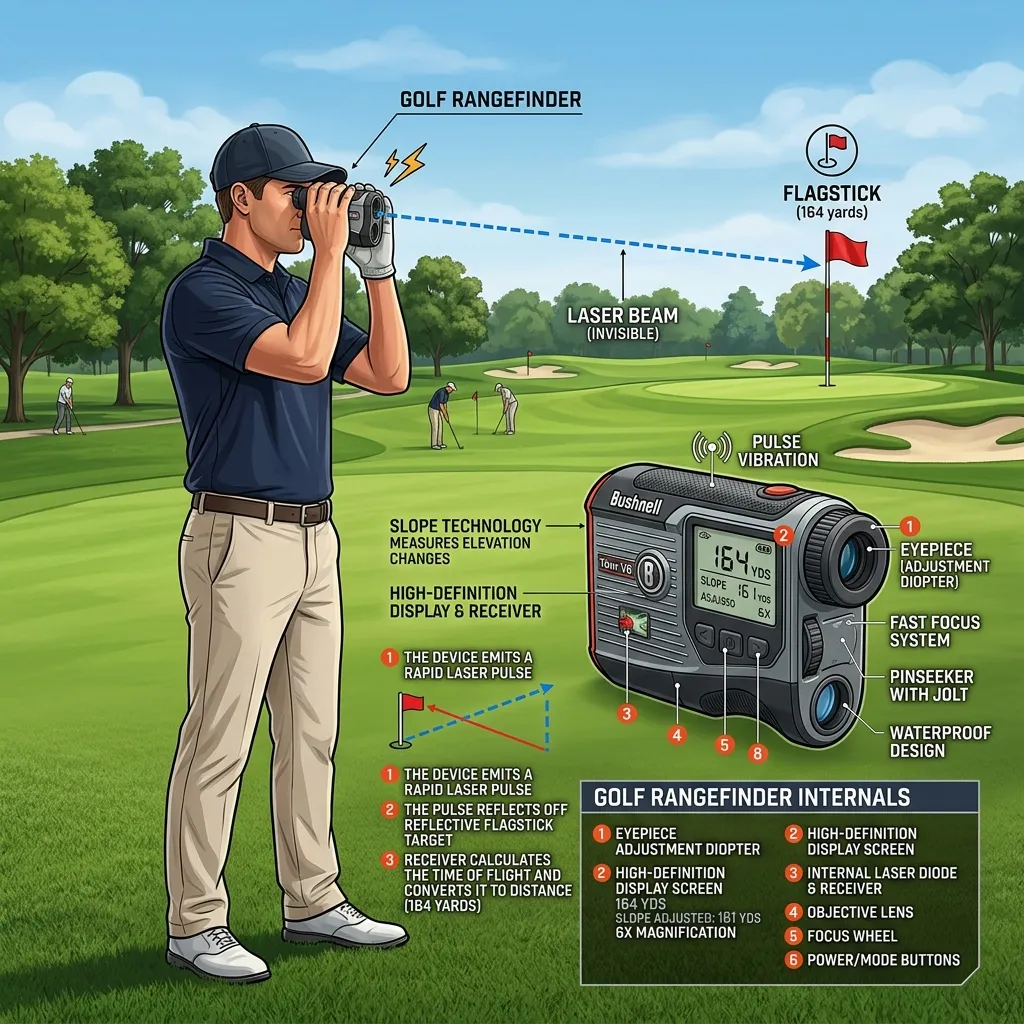
A golf rangefinder is a handheld golf distance measuring device that tells you how far you are from a target, usually the flag. Instead of pacing off yardage markers or eyeballing the green, you point, click, and get a precise number in seconds.
There are two main types: laser rangefinders and GPS rangefinders. Each works differently and suits a different kind of player.
A laser golf rangefinder fires an invisible beam at your target. The device measures how long the beam takes to bounce back, then calculates the distance. This gives you an exact reading to a specific object—the pin, a bunker lip, or a tree you want to clear.
A golf GPS device, on the other hand, uses satellite data and preloaded course maps. It shows distances to the front, center, and back of the green, along with hazards. You don’t aim at anything; the device knows where you are on the hole.
Laser golf rangefinder vs golf GPS: which should you choose?
This is the biggest decision you’ll make, so let’s compare them head to head.
When a laser rangefinder makes sense
A laser golf rangefinder gives you the most precise distance to whatever you aim at. If you like targeting the flag directly and trust your own course management, a laser is your best friend. It’s also handy for dialing in distances on the range and for shots where you need to clear a specific hazard.
Choose a laser rangefinder if pinpoint accuracy matters more to you than a broad course overview. Most laser models read distances within one yard, which is tight enough for serious players who want to attack pins.
When a golf GPS device makes sense
A golf GPS shines when you want fast, glanceable information without aiming. It’s great for players who want front-center-back numbers and hazard distances at a quick look. Many GPS units come as watches, so you don’t even need to pull anything out of your pocket.
Choose a GPS device if you value speed and convenience over hitting an exact target. It’s also a solid pick for newer golfers who are still learning a course, since it maps out the whole hole for you.
The verdict on golf GPS vs rangefinder
Many low-handicappers carry both. A laser handles precise pin distances, while a GPS gives the bigger picture. If you can only buy one, go laser for accuracy and GPS for ease. There’s no wrong answer—it comes down to how you like to play.
What is slope on a golf rangefinder?
A slope golf rangefinder measures the elevation change between you and the target, then adjusts the yardage to give you a “plays-like” distance. An uphill shot plays longer than the flat number suggests, and a downhill shot plays shorter. Slope tells you the adjusted distance so you can pick the right club.
This feature is a game-changer on hilly courses. A 150-yard shot that climbs 20 feet might actually play like 160. Without slope, you’d likely come up short.
There’s one catch: slope-enabled readings are not legal for tournament play under the Rules of Golf. That’s why most slope golf rangefinders include a switch that turns the feature off. When the slope function is disabled—usually shown by an external light or marking—the device becomes tournament-legal.
For everyday rounds and practice, slope is well worth having. If you compete often, just make sure your model lets you toggle it off.
How accurate are golf rangefinders?
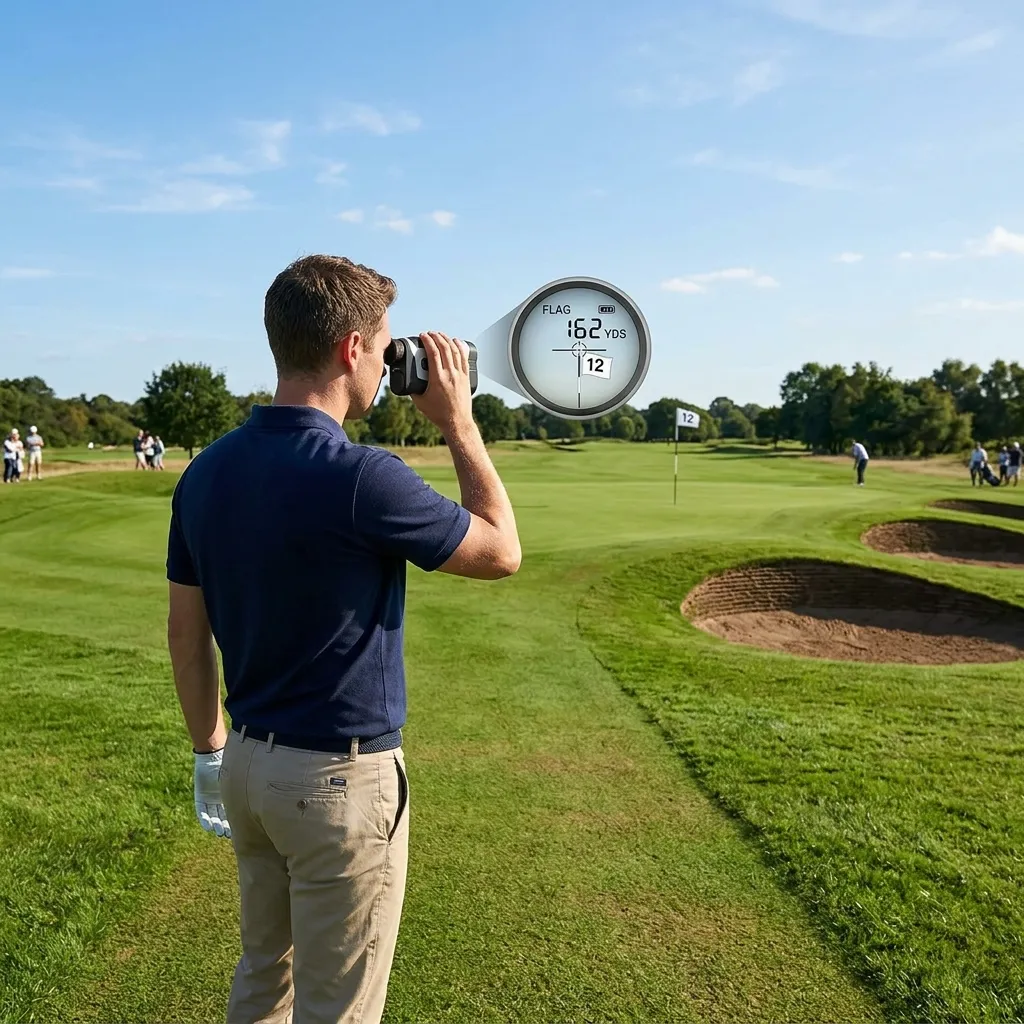
Golf rangefinder accuracy is one of the most important things to check before you buy. Most quality laser rangefinders are accurate to within one yard, and some premium models claim accuracy as tight as half a yard.
Accuracy depends on a few things:
- Magnification: Higher magnification (6x or 7x) makes it easier to lock onto distant flags steadily.
- Pin-locking technology: Good rangefinders confirm when they’ve locked onto the flag, often with a vibration or pulse, so you know you’re reading the pin and not the trees behind it.
- Steady hands: A shaky grip can throw off your aim. Many golfers stabilize their hands against a club or use a slow, smooth press.
- Range: Most rangefinders read flags up to 400–450 yards away, which is more than enough for any approach shot.
For GPS devices, accuracy is tied to course mapping rather than aiming. They’re typically accurate to within a few yards of the green’s front, center, and back plenty good for club selection, even if not as precise as a laser locked on the pin.
Key features to look for in a rangefinder for golfers
Not all rangefinders are built the same. Here are the features that genuinely affect your experience on the course.
Pin-locking and vibration feedback
This is arguably the most useful feature on any rangefinder for golfers. Pin-locking technology confirms you’ve hit the flag, usually with a short vibration. It stops you from accidentally reading the background instead of the target.
Slope adjustment with a legal toggle
As covered above, slope helps on elevation changes. The best models let you switch it off for tournaments, giving you the best of both worlds.
Magnification and display clarity
Look for at least 6x magnification. A clear display whether black LCD or bright red OLED makes flags easier to spot in different light conditions. Red displays often stand out better against green backgrounds.
Range and speed
A good golf course distance finder should read targets up to at least 400 yards and deliver a number in about a second. Faster locking keeps your pace of play moving.
Durability and water resistance
Golf happens in all weather. A water-resistant, fog-proof rangefinder will survive damp mornings and the occasional drop. Check the build quality and warranty before buying.
Battery and ease of use
Laser rangefinders usually run on a CR2 battery that lasts months. GPS units need recharging, often every one to three rounds. Pick whichever fits how often you play.
How to choose an affordable golf rangefinder
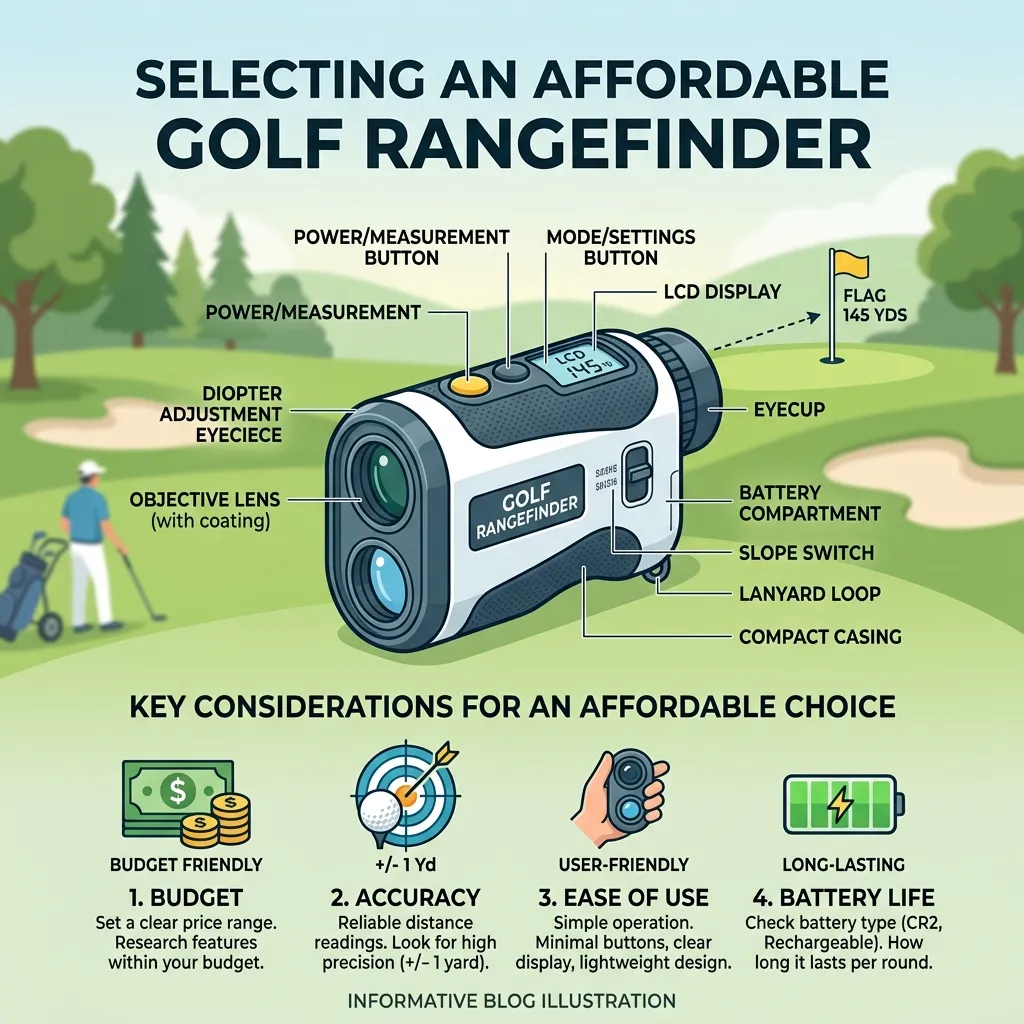
You don’t need to spend a fortune to get a reliable device. The market has expanded fast, and budget-friendly models now include features that were once premium-only.
When hunting for an affordable golf rangefinder, focus on the essentials: accuracy within one yard, pin-locking confirmation, and at least 6x magnification. If those three boxes are checked, you’ve got a device that will serve most golfers well.
Slope is the feature that often pushes the price up. Decide whether you genuinely need it. If you play flat courses most of the time, you can skip slope and save money. If you play hilly tracks, the extra cost is usually worth it.
Be wary of paying purely for brand prestige. Some mid-range and lesser-known brands offer accuracy and performance that rivals the big names at a fraction of the cost. Read reviews focused on real-world accuracy and durability rather than marketing claims.
Golf rangefinder buying guide: a quick checklist
Before you click “buy,” run through this golf rangefinder buying guide checklist:
- Type: Laser for pinpoint pin distances, GPS for full-hole overviews, or both if budget allows.
- Slope: Do you need elevation-adjusted distances? If so, confirm it has a legal toggle.
- Accuracy: Aim for within one yard for laser models.
- Magnification: 6x or higher for steady, clear targeting.
- Pin-locking: Look for vibration or pulse confirmation.
- Range: At least 400 yards is plenty for most courses.
- Display: Choose a clarity and color you can read in your usual playing conditions.
- Durability: Water resistance and a solid warranty protect your investment.
- Battery: CR2 for lasers, rechargeable for most GPS units.
- Budget: Set a number and prioritize accuracy and pin-locking over flashy extras.
Tick off these points, and you’ll land on a device that fits both your game and your wallet.
Finding the best golf rangefinder for your game
The best golf rangefinder isn’t the most expensive one—it’s the one that matches how you play. A laser model with slope and reliable pin-locking suits competitive players who attack flags. A GPS device fits golfers who want fast, glanceable course info. Budget-conscious players can find excellent accuracy without paying premium prices, as long as they focus on the features that matter.
Start by deciding between laser and GPS, then narrow down based on slope, accuracy, and price. Test the device’s locking speed and display if you can, and read honest reviews from golfers who play conditions similar to yours.
Take your new rangefinder to the range first, learn how it locks on, and build trust in its numbers. Once you do, you’ll spend less time guessing distances and more time hitting confident shots.
Frequently asked questions
Are golf rangefinders worth it?
Yes, for most golfers a rangefinder is worth it. Knowing your exact distance to the pin removes guesswork, improves club selection, and can speed up play. Even weekend players often shave strokes once they stop estimating yardage.
Are slope rangefinders legal in tournaments?
Slope-enabled readings are not legal under the Rules of Golf for tournament play. However, most slope golf rangefinders let you switch the feature off, which makes the device tournament-legal. Always confirm slope is disabled before competing.
How accurate is a golf rangefinder?
Most quality laser rangefinders are accurate to within one yard, and some premium models reach half-yard accuracy. GPS devices are typically accurate to within a few yards of the green, since they rely on course mapping rather than direct aiming.
What’s better, a golf GPS or a laser rangefinder?
A laser rangefinder gives precise distances to a specific target like the flag, while a GPS shows front-center-back and hazard distances at a glance. Choose a laser for pinpoint accuracy and a GPS for speed and convenience. Many golfers use both.
How much should I spend on a golf rangefinder?
You can find a reliable affordable golf rangefinder with accuracy within one yard, pin-locking, and 6x magnification at the lower end of the market. Slope and premium optics push prices higher, so spend based on the courses you play and the features you’ll actually use.
How far can a golf rangefinder measure?
Most golf rangefinders can read flags up to 400–450 yards away, with some premium models reaching 1,000 yards or more for non-reflective targets. For approach shots and course management, a 400-yard range is more than enough.
What is the best golf rangefinder for beginners?
A laser golf rangefinder with pin-lock technology and simple controls is usually the best choice for beginners.
Are golf rangefinders more accurate than GPS devices?
Yes, laser golf rangefinders typically provide more precise distances to specific targets like flags.
What does slope adjustment do on a golf rangefinder?
Slope adjustment calculates elevation changes and provides a “plays-like” distance for more accurate club selection.
Can I use a golf rangefinder in tournaments?
Yes, if the slope feature is disabled. Many tournament-legal golf rangefinders include a slope on/off switch.
How accurate are modern golf rangefinders?
Most quality golf rangefinders are accurate within one yard, while premium models can be even more precise.
Is a laser golf rangefinder better than a GPS golf device?
A laser rangefinder offers pinpoint accuracy, while a GPS device provides quick course layout and hazard information.
How much should I spend on a golf rangefinder?
A reliable golf rangefinder can be found at various price points, depending on features like slope, magnification, and display quality.
What features should I look for in a golf rangefinder review?
Focus on accuracy, slope adjustment, pin-lock technology, magnification, battery life, and weather resistance.
Do golf rangefinders help lower scores?
They can improve distance control and club selection, which often leads to better course management and lower scores over time.
