

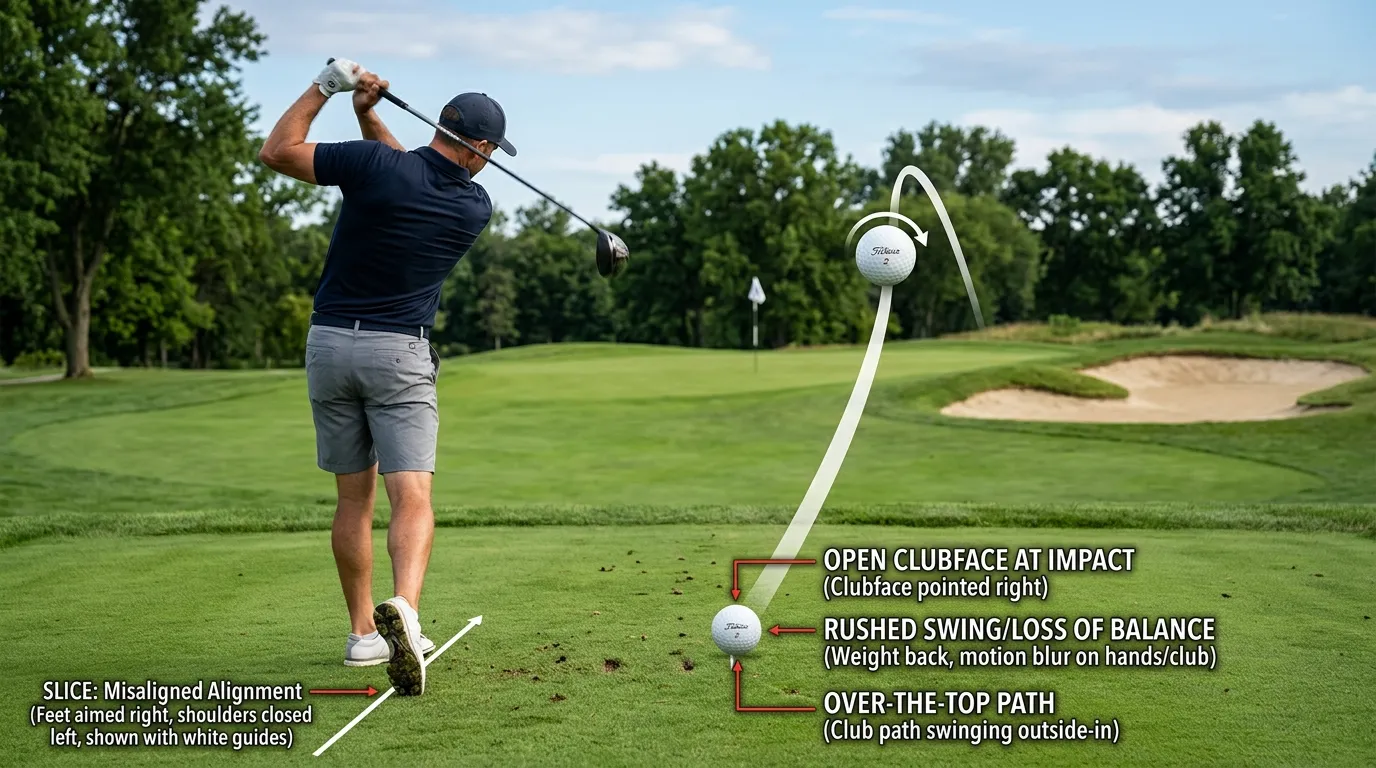
The most common golf mistakes ruining your game stem from poor fundamentals, specifically an incorrect grip, faulty posture, and bad alignment. Amateur golfers also frequently struggle with rushing the downswing and poor course management. Fixing these golf mistakes requires targeted practice, recording your swing for visual feedback, and implementing improved mental discipline during your golf rounds.
Golf is a sport of precision, patience, and mechanics. When everything clicks, hitting a golf ball pure is one of the most satisfying feelings in sports. When the mechanics break down, the game quickly becomes a frustrating series of sliced drives, chunked iron shots, and missed putts.
Every player, from total novices to seasoned veterans, battles mechanical flaws. Identifying these flaws is the critical first step toward improvement. If you do not know what is causing the golf ball to slice into the trees, you cannot possibly correct the behavior on the next tee box.
This comprehensive guide breaks down the specific amateur golfer mistakes that prevent players from lowering their handicaps. You will learn how to identify common golf swing mistakes, understand why they happen, and discover exactly how to fix golf mistakes before your next round.
What are the most common beginner golf mistakes?

Beginner golfers typically want to hit the golf ball as far as possible right away. This desire for distance causes new players to overlook the critical foundation of the golf swing: the setup. Before the golf club even moves, beginners frequently make setup errors that guarantee a poor golf shot.
Golf grip mistakes: How should you hold the golf club?
The golf grip is the only physical connection a player has with the golf club. A flawed grip directly dictates the clubface angle at impact. Many beginners hold the golf club entirely in the palms of their hands. Gripping the club in the palms restricts wrist hinge and decreases clubhead speed.
Instead, a player should hold the golf club primarily in the fingers. When you place your lead hand (the left hand for a right-handed golfer) on the golf club, the grip should run diagonally across the base of the fingers.
Another frequent golf grip mistake involves hand rotation. A “strong” grip features hands rotated too far away from the target, which often results in a closed clubface and a hooked golf shot. A “weak” grip features hands rotated too far toward the target, resulting in an open clubface and a sliced golf shot. A neutral grip, where the V-shapes formed by the thumbs and forefingers point toward the trail shoulder, provides the most consistent clubface control for the average amateur golfer.
Golf posture mistakes: Are you standing correctly?
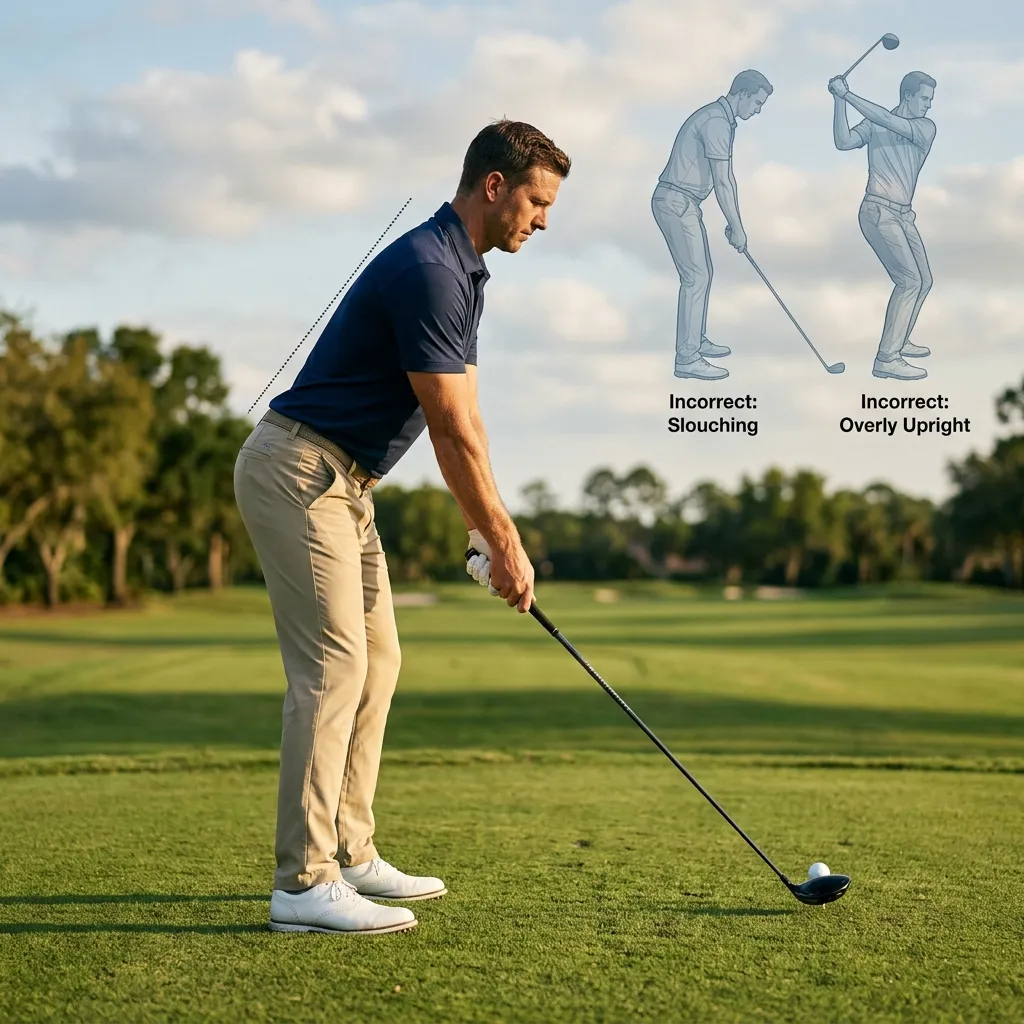
Proper golf posture provides the balance and space necessary for the golf club to swing freely around the body. Golf posture mistakes usually fall into two categories: slouching over the golf ball or standing entirely too straight.
Slouching rounded shoulders restrict the torso’s ability to rotate. When the torso cannot rotate, the golfer must lift the golf club entirely with the arms. This arm-only swing creates a steep angle of attack, leading to deep divots and heavy golf shots.
Standing too upright forces the golfer to reach for the golf ball. Reaching shifts the player’s weight onto the toes, which ruins balance during the golf swing.
Proper golf posture requires the player to hinge at the hips while keeping the back relatively straight. The knees should have a slight flex, and the player’s body weight should rest evenly over the shoelaces. This athletic posture allows the shoulders to turn properly on the backswing and downswing.
Which golf swing mistakes are ruining your game?
Once the setup is correct, the golfer must execute the swing itself. The golf swing happens in less than two seconds. Within that brief window, several complex movements must synchronize perfectly.
Golf downswing mistakes: Are you rushing the transition?
The transition from the top of the backswing into the downswing is where most amateur golfer mistakes occur. The most destructive flaw is the “over-the-top” move.
An over-the-top golf swing happens when the player initiates the downswing using the arms and shoulders rather than the lower body. The trail shoulder spins outward, throwing the golf club outside the target line. The club then cuts across the golf ball at impact, imparting heavy side-spin. This spin produces the dreaded slice.
A proper downswing must initiate from the ground up. The sequence should begin with a weight shift to the lead foot, followed by the rotation of the hips, the rotation of the torso, and finally the release of the arms and the golf club. By starting the downswing with the lower body, the golf club drops slightly behind the player, allowing the clubhead to attack the golf ball from the inside path.
Golf alignment mistakes: Are you aiming where you think you are?
Golf alignment mistakes deceive the player. A golfer might execute a mechanically flawless golf swing, strike the golf ball perfectly, and still watch the ball miss the green by thirty yards because they aimed poorly.
Amateur golfers frequently align their feet at the target. Because the golf ball sits roughly two feet away from the player’s body, aligning the feet directly at the target means the clubface is actually aiming to the right of the target (for a right-handed golfer).
Proper golf alignment works like railroad tracks. The outer track represents the target line, connecting the golf ball to the flagstick. The inner track represents the body line. The player’s feet, knees, hips, and shoulders must align parallel to the target line, not intersecting with it.
What are the biggest mistakes golfers make on the course?

Golf mistakes ruining your game are not exclusively mechanical. Many strokes are lost due to poor decision-making during a round of golf. Course management separates the strategic player from the reckless player.
Selecting the wrong golf club for the approach shot
Amateur golfers consistently overestimate how far they hit their golf clubs. A player might hit a 7-iron 150 yards one time perfectly, and from that day forward, they assume their 7-iron always travels 150 yards. In reality, their average 7-iron might only travel 135 yards.
When facing a 150-yard approach shot, this player selects the 7-iron. They make decent contact, but the golf ball lands short of the green, splashing into a front bunker. Choose your golf club based on your average distance with that club, not your absolute maximum distance. Taking one extra club and swinging smoothly yields far better results than swinging out of your shoes with a shorter club.
Aiming at every single flagstick
Course architects design golf greens to challenge the player. They place flagsticks near deep bunkers, water hazards, and steep slopes. A major mistake golfers make on the course is aiming directly at the flagstick regardless of the danger surrounding it.
If the pin sits three paces from a water hazard on the right side of the green, aiming right at the pin invites disaster. A slight miss to the right results in a penalty stroke. The correct strategic decision is aiming for the center of the green. Hitting the center of the green guarantees a putt for birdie and takes the penalty area out of play completely.
How can players fix these common golf mistakes?
Understanding the flaws is only half the battle. Fixing golf mistakes requires deliberate practice routines and objective feedback.
Choose professional instruction if your swing mechanics feel entirely broken and you cannot make consistent contact with the golf ball. A certified PGA professional can identify the root cause of your golf swing mistakes much faster than you can diagnose them yourself.
Choose video analysis if you are an experienced player struggling with a specific new flaw. Modern smartphones record high-frame-rate video. Set up a camera directly behind your hands down the target line, and set up another camera facing your chest. Compare your golf posture, golf alignment, and golf downswing against professional models. You will immediately see if your posture is too upright or if your downswing path is coming over the top.
When practicing on the driving range, never hit golf balls rapidly without a target. Place an alignment stick on the ground between your feet and the golf ball to ensure your body aims parallel to your target line. Step away from the golf ball after every single shot, re-evaluate your golf grip, and walk back into the setup fresh. This builds muscle memory for the golf course.
Actionable Next Steps to Lower Your Golf Handicap
Lowering your golf scores requires a commitment to fundamental mechanics and smarter course management. Identify the one flaw that causes you the most penalty strokes—whether that is a weak golf grip, a rushing downswing, or poor club selection—and dedicate your next three practice sessions exclusively to that issue. Record your golf swing, utilize alignment sticks on the driving range, and aim for the center of the greens during your next round. By eliminating these unforced errors, you will immediately start signing better scorecards.
Frequently Asked Questions
How long does it take to fix a major golf swing mistake?
Changing a deeply ingrained motor pattern in the golf swing typically takes a player between four and eight weeks of consistent, deliberate practice. The new movement will feel awkward initially, and scores may briefly increase before the new mechanics become natural.
Why do I hit my golf irons well but slice my driver?
The driver is the longest club in the bag and has the lowest loft, which magnifies any side-spin applied to the golf ball. An over-the-top downswing path that produces a slight, manageable fade with a 9-iron will produce a severe, unplayable slice with a driver due to the length of the club and the physics of the impact.
Are oversized golf grips better for amateur players?
Choose oversized golf grips if you suffer from arthritis or if you have a tendency to grip the golf club with excessive tension. Thicker grips limit hand action during the golf swing, which can help players who struggle with a hook, but they may hinder players who struggle to close the clubface in time for impact.
What is the fastest way to stop hitting the ground before the golf ball?
Hitting the ground before the ball (a “chunked” shot) usually results from a reverse pivot, where the player’s weight remains on the trail foot during the downswing. To fix this, focus on shifting your belt buckle toward the target before your hands pull the golf club down to the ball.
