


Amateur golfers improve fastest by mastering swing fundamentals, building a strong short game, and following a structured practice routine. Consistent training, professional instruction, smart course management, and participation in amateur tournaments help golfers lower scores, reduce handicaps, and enjoy the game more.
Improving as an amateur golfer requires mastering swing fundamentals, practicing with purpose, and developing a consistent routine. Beginners should prioritize grip, stance, and tempo before focusing on distance. Structured lessons, targeted drills, and competing in amateur tournaments accelerate skill development faster than range time alone.
Golf has a reputation for being hard to learn and even harder to master. That reputation isn’t entirely undeserved—but it is misleading. Most amateur golfers don’t struggle because the game is impossible. They struggle because nobody gave them a clear roadmap.
This guide changes that. Whether you’ve just picked up a club for the first time or you’ve been grinding through a frustrating high handicap for years, the advice here is practical, structured, and built around how recreational golfers actually learn. You’ll find beginner golf tips, swing fundamentals, practice drills, and strategies for taking your game to the next level—including how amateur tournaments can accelerate your development faster than solo range sessions ever will.
By the end, you’ll know exactly what to work on, how to practice it, and where to go from here.
What Does It Mean to Be an Amateur Golfer?

The term “amateur golfer” covers a wide spectrum. At one end, you have complete beginners who are still figuring out how to hold a club. At the other, you have single-digit handicappers competing in club championships and state-level events. What unites them is that they play for the love of the game—not a paycheck.
According to the National Golf Foundation, approximately 26 million Americans play golf each year. The vast majority are recreational golfers who play fewer than 25 rounds annually. Most carry handicaps above 18, placing them firmly in the high-handicap category.
That’s not a failure. It’s an opportunity. High-handicap golfers have the most room for improvement, and even small technical adjustments can produce dramatic results on the scorecard.
Golf Swing Fundamentals Every Beginner Should Know
Before worrying about swing speed or shot shape, amateur golfers need to nail the basics. The golf swing is a complex athletic movement, but it’s built on a handful of foundational elements. Get these right, and everything else becomes easier.
How should a beginner hold a golf club?
The grip is where everything starts. A poor grip creates compensations throughout the entire swing—compensations that become harder to fix the longer they go uncorrected.
There are three main grip styles: the overlapping (Vardon) grip, the interlocking grip, and the ten-finger (baseball) grip. Most golf instructors recommend beginners start with the interlocking grip, made famous by Tiger Woods and Jack Nicklaus, because it promotes a unified hand action through impact.
Key checkpoints for a solid grip:
- Grip pressure: Hold the club firmly but not tightly. A pressure scale of 5 out of 10 is a common benchmark.
- Lead hand position: The grip should run diagonally across the fingers, not across the palm.
- Knuckle visibility: When you look down at your lead hand, you should see two to three knuckles.
What is the correct golf stance for beginners?
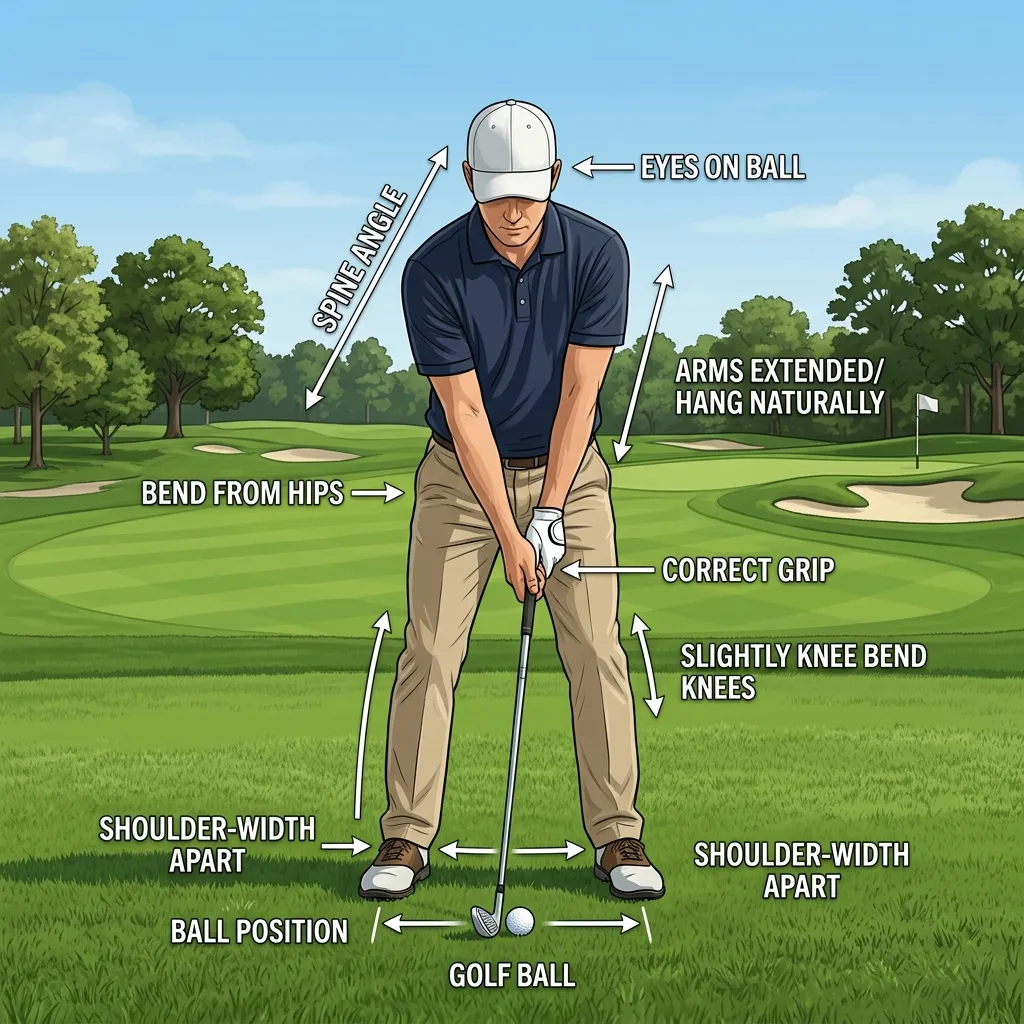
Stance sets up everything that follows. Feet should be roughly shoulder-width apart for mid-irons, slightly narrower for short irons, and slightly wider for driver. Weight distribution should be roughly even between both feet at address.
Ball position shifts depending on the club—further forward in the stance for the driver, progressively more central as you move to shorter irons. Spine tilt, knee flex, and hip hinge all matter too, but beginners should focus on balance and posture before worrying about fine-tuning.
How does swing tempo affect ball striking for amateur golfers?
Tempo is one of the most underrated fundamentals in golf—and one of the most commonly ignored by beginners.
Research from Titleist Performance Institute suggests that the most consistent ball strikers maintain a 3:1 ratio between backswing and downswing time. That means the backswing takes three times as long as the downswing. Rushing the transition—the moment the club changes direction at the top—is the single most common swing error among high-handicap golfers.
A slow, deliberate backswing followed by an accelerating downswing produces more consistent contact than trying to muscle the ball with raw speed.
Golf Training for Beginners: Where to Start
Knowing what to work on is one thing. Knowing how to build a training routine is another. Many beginner golfers make the mistake of heading straight to the driving range and hitting balls aimlessly for an hour. It feels productive. It rarely is.
Structured golf training for beginners should focus on three areas: technical skill, on-course decision-making, and short game proficiency.
Should beginner golfers take lessons?
Yes—and ideally before developing bad habits that become expensive to fix later.
Golf lessons for beginners don’t need to be frequent or costly. Even a series of three to five lessons with a certified PGA professional can provide a framework that guides independent practice for months. The key is finding an instructor who communicates clearly, understands how recreational golfers learn, and avoids overwhelming beginners with too much technical information at once.
Many golf clubs and driving ranges offer group beginner clinics, which are a cost-effective way to get started. Platforms like Golf Channel Academy and the USGA’s own instruction resources also provide high-quality video content for self-directed learners.
What are the most effective golf practice drills for beginners?
The short game accounts for roughly 60% of all shots in a typical round. That statistic, widely cited by golf instructors and coaches, makes a compelling case for where beginners should spend the majority of their practice time.
Effective drills for golf skills development:
- The 9-Ball Putting Drill: Place nine balls around a hole at varying distances (3, 6, and 9 feet). The goal is to sink all nine consecutively. This drill builds pressure tolerance and reinforces consistent putting stroke mechanics.
- The Gate Drill: Set two tees just wider than your putter head along the target line. Practice stroking the ball through the gate without touching either tee. Instantly identifies a crooked putting stroke.
- Chip and Catch: Practice chipping to a target, then catch the ball before it rolls. The focus shifts from outcome to contact quality—one of the fastest ways to improve chipping consistency.
- Impact Bag Training: Striking an impact bag helps golfers feel the correct position at the moment of contact. Particularly useful for beginners who flip their wrists through impact.
- Tempo Counting: During full swings, count “one” on the backswing and “two” on the downswing. This simple cue helps regulate tempo and eliminate the rushed transition that causes most topped and thin shots.
Golf Improvement Strategies for High Handicap Golfers

High-handicap golfers—typically those carrying a handicap index above 18—often try to fix their game by adding distance. More often than not, the real issue is consistency and course management.
What are the best golf improvement strategies for recreational golfers?
1. Eliminate blow-up holes. One triple bogey erases the benefit of three pars. High-handicap golfers improve their scores faster by focusing on damage limitation—taking an unplayable lie penalty, laying up short of trouble, or pitching out sideways—rather than attempting hero shots from difficult positions.
2. Prioritize short game practice over driving range sessions. As noted above, the short game dominates stroke counts for recreational golfers. Spending 60% of practice time within 100 yards of the hole produces faster scoring improvement than working on the driver.
3. Track your misses, not just your scores. Using a simple app like Grint or 18Birdies to log fairways hit, greens in regulation, and putts per round reveals patterns that are invisible to casual observation. That data makes practice sessions significantly more targeted and effective.
4. Play to your actual skill level, not your aspirational one. Choosing the right set of tees matters more than most recreational golfers realize. Playing tees that match your current ability makes the game more enjoyable and produces better learning outcomes than struggling from the back tees.
Amateur Golf Tournaments: Why Competing Accelerates Development
There’s a ceiling to how much you can improve through practice alone. Competition adds stakes, pressure, and a feedback loop that casual rounds simply don’t replicate.
What types of amateur golf tournaments are available for recreational players?
Amateur golfers have more competitive options than many realize:
- Club championships and member-guest events: Most golf clubs run their own annual tournaments, often handicapped to give recreational players a fair chance.
- USGA Amateur events: The USGA administers the US Amateur, Mid-Amateur, and Senior Amateur championships. Entry requires a valid USGA handicap index.
- State and regional amateur associations: Every US state has a golf association that runs amateur events across multiple handicap categories.
- Net score tournaments: Many local and regional events use handicap-adjusted net scoring, making competition accessible even for high-handicap players.
Competing in even one or two tournaments per season creates clear improvement goals, sharpens on-course decision-making, and builds the mental resilience that separates improving golfers from those who plateau.
Building a Long-Term Golf Skills Development Plan
Sustainable improvement in golf doesn’t happen in a single season. It happens through deliberate, consistent effort over time—guided by clear goals, honest self-assessment, and a willingness to seek help when progress stalls.
A practical framework for amateur golfers:
- Assess your current game honestly. Track stats for five rounds to identify your biggest weaknesses.
- Book a lesson. Even one session with a qualified instructor can provide months of direction.
- Structure your practice. Allocate time deliberately—short game, full swing, course management—rather than defaulting to hitting drivers until your bucket is empty.
- Set a handicap goal. A specific, measurable target keeps motivation high and progress visible.
- Enter a tournament. Competitive experience is irreplaceable. Find a local event and sign up.
Your Next Round Starts Here
Golf rewards patience, consistency, and smart practice more than raw talent. The amateur golfers who improve fastest aren’t necessarily the most athletic—they’re the ones who practice with intention, seek qualified instruction, and treat every round as a learning opportunity.
Start with the fundamentals. Build a short game. Track your stats. And when you’re ready, step onto the first tee of a tournament and discover just how much you’ve grown.
Frequently Asked Questions
How long does it take for a beginner golfer to break 100?
Most beginners can break 100 within one to two years of consistent play and structured practice. Taking lessons early, focusing on the short game, and playing regularly are the three factors most correlated with faster improvement.
What is a good handicap for an amateur golfer?
The average golf handicap in the United States is approximately 14.2 for men and 26.5 for women, according to the USGA. A handicap below 10 is generally considered strong for a recreational player. Anything below 5 places an amateur golfer in the top tier of non-professional players.
How many times per week should an amateur golfer practice?
Two to three focused practice sessions per week produces meaningful improvement for most recreational golfers. Quality matters more than quantity—a 45-minute session with clear drills and goals outperforms two hours of aimless range time.
What is the most important skill for beginner golfers to develop first?
Putting and chipping. The short game accounts for the majority of strokes in a typical round, and improving within 50 yards of the hole produces faster score reduction than working on the full swing.
Do amateur golfers need expensive equipment to improve?
No. Equipment can help at the margins, but fundamentals—grip, stance, tempo, short game—are far more important than club technology for beginner and high-handicap golfers. A fitted set of mid-range irons and quality golf lessons will improve your game more than the latest driver.
What is the best way for a high-handicap golfer to lower their score quickly?
Eliminate penalty shots and blow-up holes. Course management—making conservative decisions, avoiding trouble, and playing to your strengths—has a more immediate impact on scoring than any single technical improvement.
